War with Iran has pushed the genocide of Palestinians out of the mainstream media. Some believe this is intentional. I continue to think that if the people in this country really knew what has been happening, they would demand change. It is nothing short of ethnic cleansing. I write daily to share what I learn. The subtitle of my blog unflinching.blog is “do not look away”.
Ethnic cleansing is the systematic forced removal of ethnic, racial, or religious groups from a given area, with the intent of making the society ethnically homogeneous. Along with direct removal such as deportation or population transfer, it also includes indirect methods aimed at forced migration by coercing the victim group to flee and preventing its return, such as murder, rape, and property destruction. Wikipedia
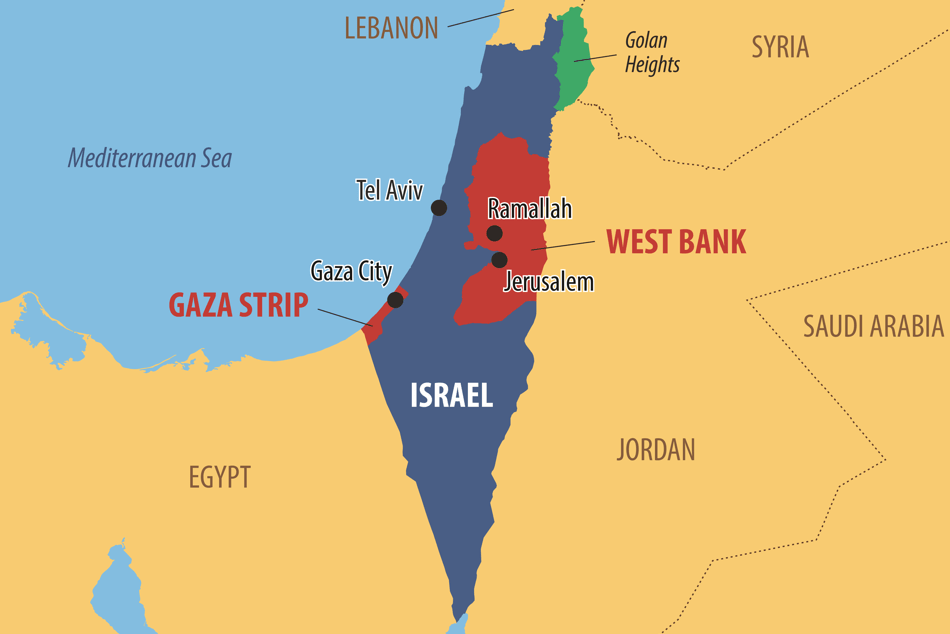
Palestinians live under Israeli occupation in Gaza and the West Bank . The films ‘No Other Land’ and ‘5 Broken Cameras’ were both filmed in the West Bank.
As a photographer I can relate to the concept of years of photo documentation. Over a decade ago I began to carry my camera with me ‘everywhere’.
When I learned about the film ‘No Other Land’, I could immediately relate to Basel Adra’s five years of photo documentation of the Israeli incursions into his hometown of Masafer Yatta in the West Bank.
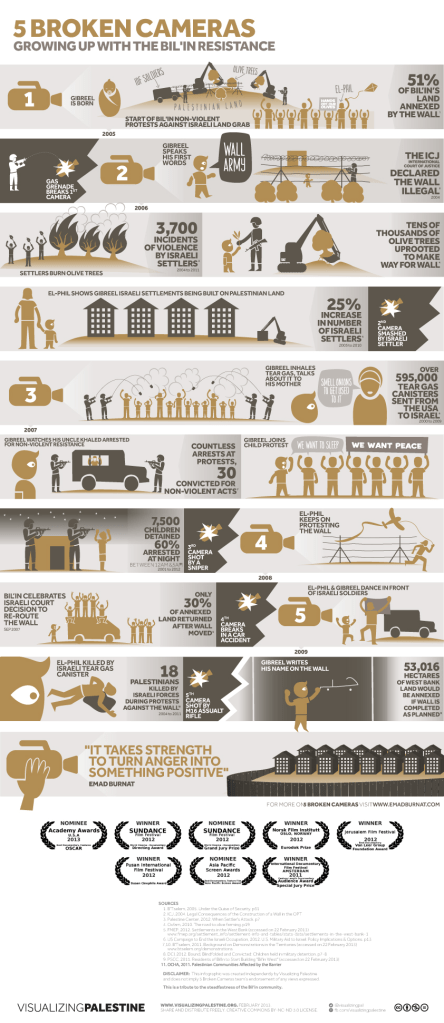
‘5 Broken Cameras’ is a first-hand account of protests in Bil’in, a West Bank village affected by the Israeli West Bank barrier. The 94-minute documentary film was co-directed by Palestinian Emad Burnat and Israeli Guy Davidi. The documentary was shot almost entirely by Palestinian farmer Emad Burnat, who bought his first camera in 2005 to record the birth of his youngest son. It is remarkable because it conveys what is happening through a child’s eyes.
The title, ‘5 Broken Cameras’, refers to Emad Burnat using 5 different cameras during that time. “Broken” refers to the times when each camera was broken. The last camera was thought to have saved Emad’s life when a bullet struck it.
Nonviolence
‘5 Broken Cameras’ clearly shows the most inspiring nonviolent struggle I have seen in a long time. The Palestinian families, including children, frequently confront armed Israeli soldiers with only Palestinian flags and their voices. Emad says he hopes “capturing these images will have to mean something.”
Visualizing Palestine
5 Broken Cameras is a 94-minute documentary film co-directed by Palestinian Emad Burnat and Israeli Guy Davidi. It was shown at film festivals in 2011 and placed in general release by Kino Lorber in 2012. 5 Broken Cameras is a first-hand account of protests in Bil’in, a West Bank village affected by the Israeli West Bank barrier. The documentary was shot almost entirely by Palestinian farmer Emad Burnat, who bought his first camera in 2005 to record the birth of his youngest son. In 2009 Israeli co-director Guy Davidi joined the project. Structured around the destruction of Burnat’s cameras, the filmmakers’ collaboration follows one family’s evolution over five years of turmoil. The film won a 2012 Sundance Film Festival award, the Golden Apricot at the 2012 Yerevan International Film Festival, Armenia, for Best Documentary Film, the 2013 International Emmy Award, and was nominated for a 2013 Academy Award. https://visualizingpalestine.org/visual/5-broken-cameras/
No Other Land
The Oscar-winning documentary, No Other Land, is now streaming in the US for the very first time.
This powerful film follows a Palestinian journalist and co-director Basel Adra and his hometown of Masafer Yatta, a rural community where Israel has been violently forcing Palestinian families out of their homes for decades. Basel began filming as a teenager—capturing Israel’s violent attacks on his neighbors, his home, and his family.
This isn’t just a story about the past. It documents an ongoing struggle—for dignity, for land, and for survival.
Watch No Other Land and share it with your family and friends. All proceeds go directly to support the people of Masafer Yatta. Palestinian stories matter—and they need to be heard.
The documentary “No Other Land” — created by Basel Adra, Yuval Abraham, Hamdan Ballal, and Rachel Szor — has sparked intense reactions from both Palestinians and Israelis. Recently awarded the Oscar for Best Documentary, the film has become more than just a piece of art — it’s a mirror reflecting the painful, shared reality we live in.
On the Israeli side, some feel embarrassed by the film, dismissing it as anti-Israel propaganda. Others struggle with what it means to face this truth, as if acknowledging the occupation and forced displacement of Palestinian villages like Masafer Yatta is a betrayal of their identity.
On the Palestinian side, there are those who embrace the film but view it solely as a “Palestinian film,” almost erasing Yuval Abraham’s presence — as if collaborating with an Israeli in the fight against oppression undermines the Palestinian cause. Some have even labeled it “normalization,” arguing that working alongside an Israeli is a sign of weakness or inferiority.
But here’s the truth: this film is both PALESTINIAN & ISRAELI — because our crisis is Palestinian-Israeli. No side can escape it alone, and no side can solve it alone.
“No Other Land” was born from the partnership of two Palestinians and two Israelis who chose to stand together — not by ignoring the occupation, but by actively resisting it together. They are partners in the struggle against injustice, pushing for a future grounded in empathy, equality, and mutual security for both peoples.
And let’s be honest — when the extremes on both sides attack a work, calling it “anti-Israel” on one hand and “normalization” on the other, it often means something right is happening. It means the film has struck a nerve — challenging the black-and-white narratives that keep us apart.
This documentary is a bold reminder that our destinies are intertwined. A just and lasting peace will come from joint struggle, not isolated narratives.
Because the hard truth is — there is NO OTHER LAND FOR ANY OF US. 
 unflinching