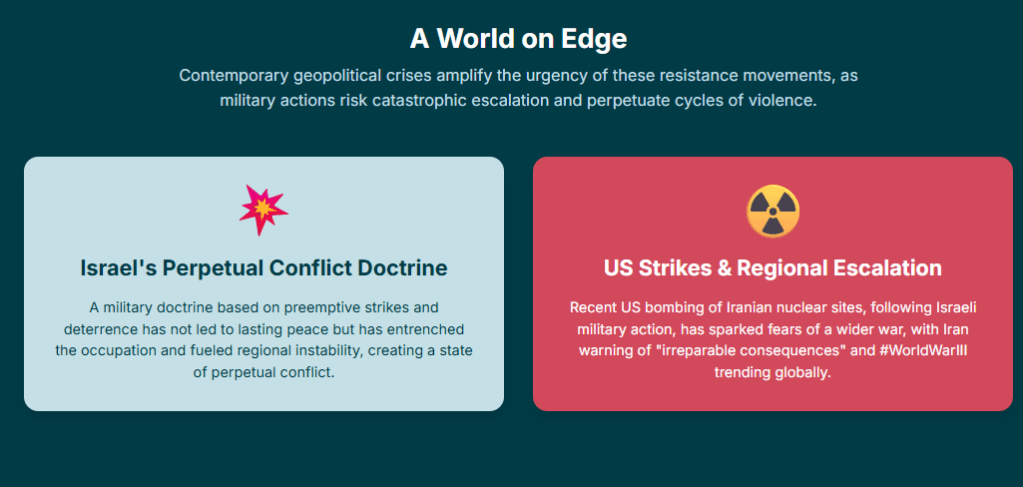
You may be among those of us who have worked tirelessly for peace. We are all now confronted with the US bombing of Iran. We are weary to our bones. Many of us are asking what more we could have done. Wondering where we’ll get the strength to continue to work for peace. Wonder what we can do now.
The title Need new peace movement now, is not to diminish any of the work for peace that individuals, faith groups and other organizations have done to this point.
What I am doing at this moment, and encouraging you to do now is to pray for guidance for what to do now. We can’t allow our focus to be hijacked into dwelling on this atrocity. We must not only continue our peace efforts, but look around for others who share our beliefs that we haven’t, for whatever reason, connected with, yet. Build a new peace movement, built on years of work we have already done. But now look more globally for peacemakers to join us, for us to join them, at this horrible time.
Impact of Resistance Movements
The impact of resistance movements can be measured in two crucial ways: direct policy change (more evident in the US case) and the enduring moral witness that challenges societal norms, shapes public discourse, and leaves a legacy for future generations, even without immediate policy shifts. Both types of impact are valuable. For movements operating in highly repressive or deeply militarized contexts where direct policy change is difficult, maintaining a strong moral witness, documenting resistance, and fostering internal societal debate become crucial forms of long-term impact, laying the groundwork for potential future shifts. This highlights the long game of social movements, where immediate outcomes do not always define ultimate success.
Quakers and Peace
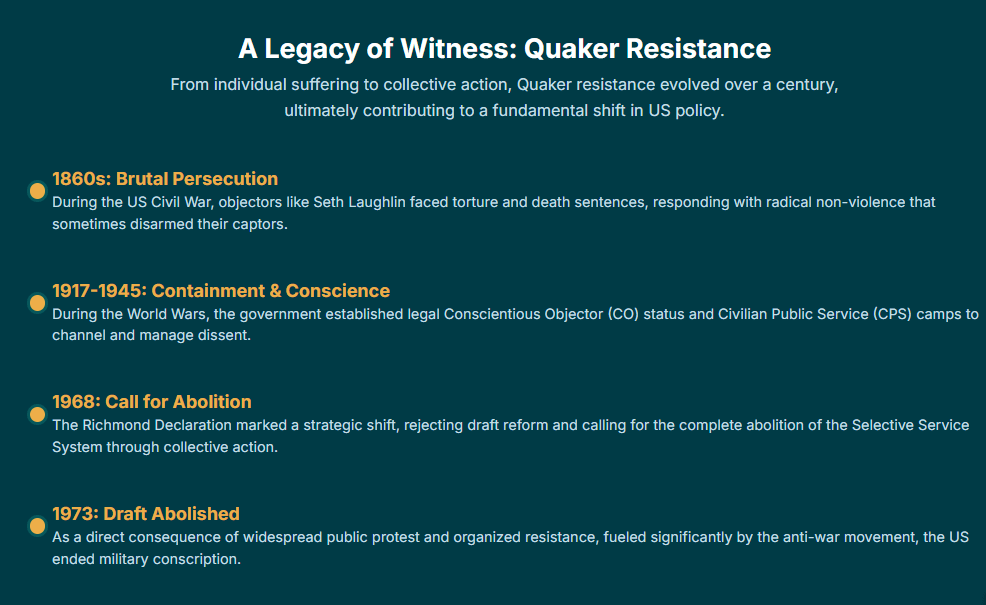
I am a Quaker and have worked for peace my whole life. I organized a draft conference at Scattergood Friends School in 1969 and I attended the Richmond Draft Conference in Richmond, Indiana, that year. That date is significant to me because that is the year I turned 18, the time when I would be legally required to register with the draft (Selective Service System).
New Peace Movement
There is significant and often dangerous peace work being done by millions of people all over the world.
- My draft resistance to the Vietnam War was work for peace.
- My whole life I’ve worked in my Quaker communities to support peace and justice
- Working for Friends Volunteer Service Mission was work for peace.
- Working with the Kheprw Institute in Indianapolis was work for peace.
- My years as a member of Des Moines Mutual Aid is peace work. There I learned how to intentionally reject authority, and focus on the survival needs of the neighborhood surrounding the church where we assembled boxes of donated food for distribution.
- Working with the Great Plains Action Society to support their Indigenous efforts is peace work.
- My current work to support Palestinians is peace work.
My vision of a New Peace Movement is one the created by more intentionally connecting with all of this work. A global mutual aid movement.
Refuser Solidarity Network
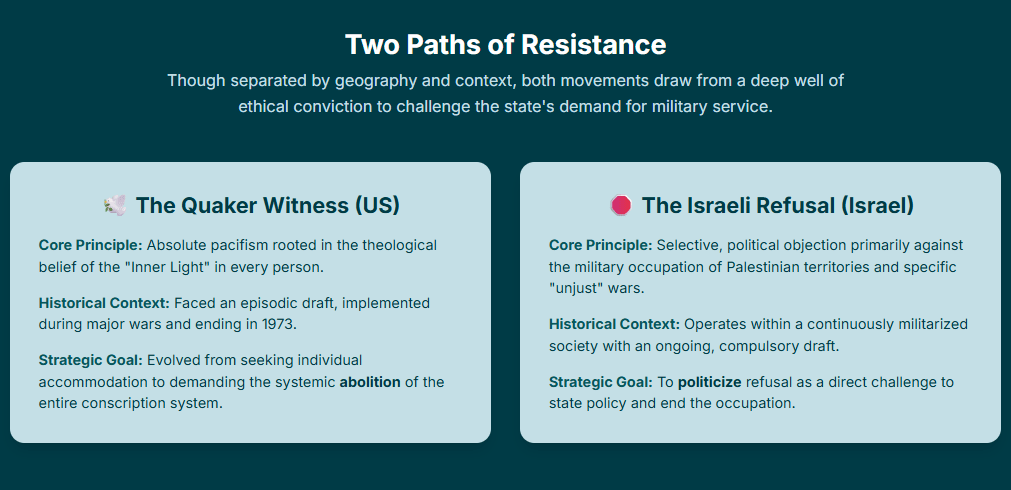
A group I intend to make connections with is the Israeli Refuser Solidarity Network whose focus is on resistance to Israeli military conscription.
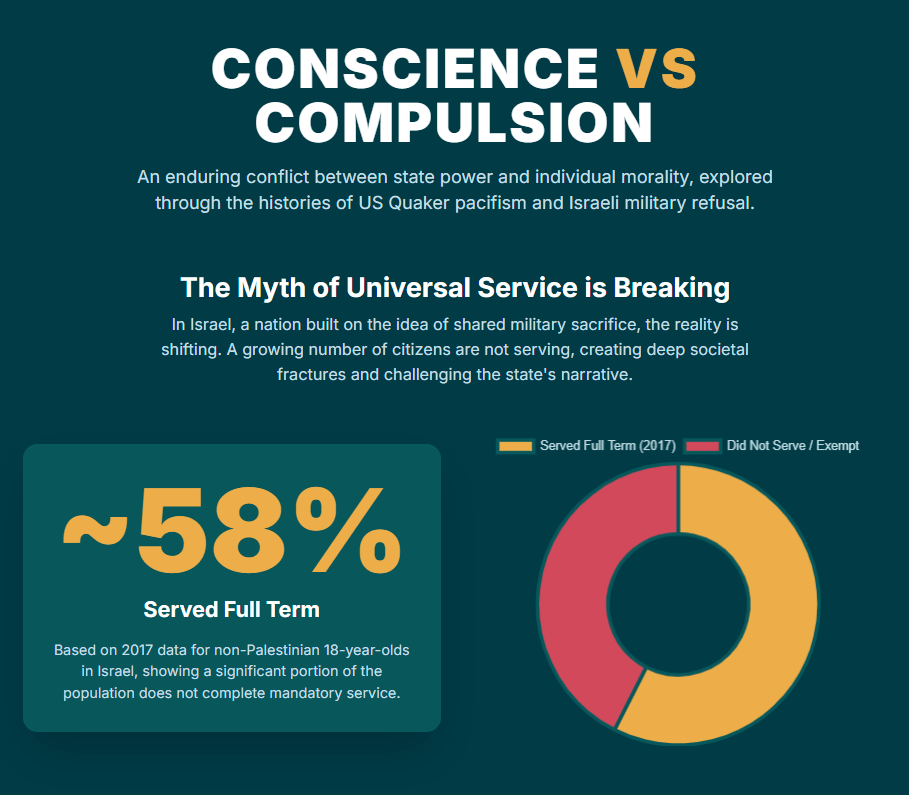
In a militarized society like Israel, built on mandatory service, refusal has always been a powerful way to force the government to back down. There can be no occupation with no soldiers. Today, we at Refusal Solidarity Network are aggressively supporting those leading the latest wave of refusal and fighting to bring the genocide to an end. Our ability to support emerging groups of refusers is expanding. We successfully backed several reservists in forming the group Soldiers for Hostages over the last year. However the need to support crucial anti-war initiatives grows even faster, especially as Israel expands its regional assault to include Iran, we need more support from our friends around the world.

The principled stands of Quaker pacifists and Israeli refusers become even more significant. Their historical and ongoing commitment to non-violence and resistance to military compulsion offers a vital counter-narrative to the prevailing reliance on military force. The increasing internal pressures on Israel’s conscription system, coupled with the external risks of regional war, create a fertile environment for the growth and impact of refusal movements. Their actions not only challenge specific policies but also the fundamental assumption that military might is the sole path to security. This intersection of escalating geopolitical tensions and internal societal fragilities amplifies the call for conscience-driven resistance, making it an increasingly relevant and necessary force for peace and social change.
Infographic
This is an infographic I was able to create from these ideas.



Disclaimer: I’ve been working on documents like this for a long time. More recently, I’ve been using artificial intelligence tools to uncover history I wasn’t aware of, and show me the relationships between what is uncovered.
I’ve ONLY been using AI tools that use a “reasoning model”, which means the model will continue along paths it is discovering in real time. The model displays every reference it used, and footnote links in the evolving document to where those sources were actually used. I also use AI tools to generate Infographics from my own sources, to display what I’m trying to convey in a different way.
 unflinching