It’s difficult to continue to witness the relentless genocide in Gaza. And to watch those in political power in the United States and Israel continue to completely disregard the Palestinian people at this crucial juncture in the situation there.
I’ve long been aware of the solidarity between the Palestinians and the native, indigenous peoples of the United States. Aware of the land theft and genocide committed against both peoples.
I’ve also been aware of land acknowledgements in this country for awhile. Although an indigenous friend of mine said he doesn’t like what they have become.
But it occurs to me that a land acknowledgement for Palestine might be worthwhile, as a tool for learning if nothing else. Unsurpisingly, many others have already thought and written about land acknowledgement for Palestine.
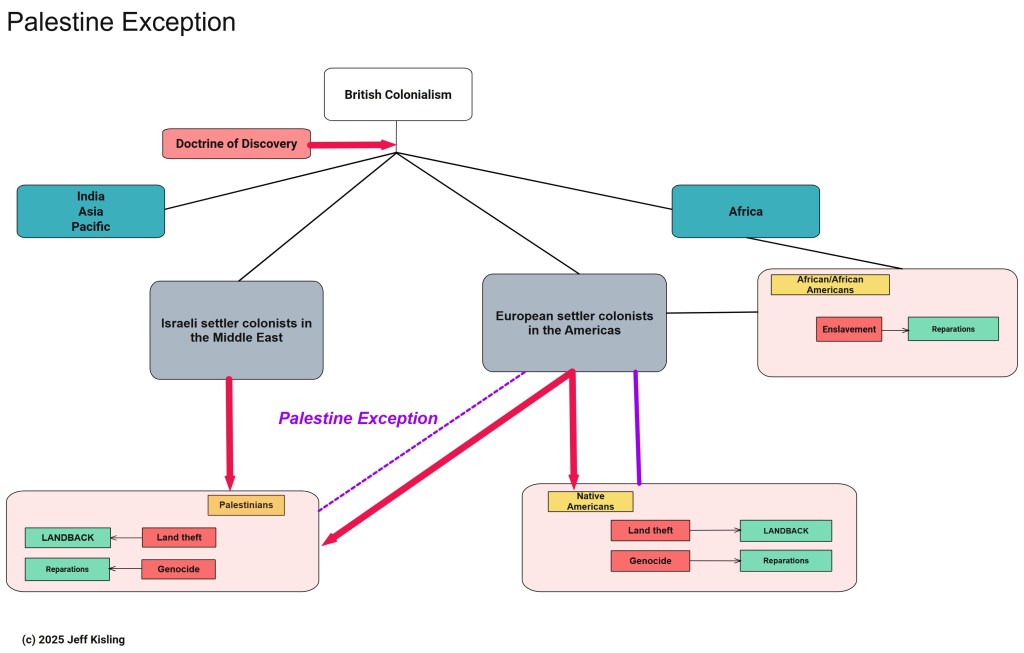
I learned something right away, the “Palestinian Exception.”
“Palestinian Exception”
A significant critique arises regarding the application of the principles behind land acknowledgment to the context of Palestine. This critique is captured by the term “Palestine Exception”. The Palestine Exception refers to the observation that institutions, like universities in the US, simultaneously affirm statements acknowledging historical US colonialism on national territory through land acknowledgments while responding with violence, policing, and disciplinary action against protests that challenge the US’s central role in supporting contemporary settler colonialism and genocide in Palestine.
The hypocrisy highlighted by the Palestine Exception lies in the contrast between acknowledging past colonialism on the land the university, for example, occupies and the refusal to extend this acknowledgment of solidarity to the Palestinians. Despite institutional land acknowledgments, many universities are criticized for vehemently refusing to discuss their integral role in the military-industrial complex that supports the settler colonial occupation of Palestine and actions described as genocide in Gaza through investments.. The refusal to adequately respond to the settler colonial project of the United States is seen as running parallel to the repudiation of Israel as a settler colonial project.
LAND & PALESTINE ACKNOWLEDGMENT
Wayʼ
The That’s What [We] Said Journal wants to take the time to recognize that our sixth edition, Pleasure, was created, edited, and produced as Palestinians are experiencing overt genocide. We remind ourselves and our readers that as we engage with this journal within the realm of relative safety, Palestinians have been facing 76 years of settler colonialism and since October 7th 2023 undergoing an ethnic cleansing and currently do not have access to basic human needs. We, also, acknowledge that our journal is produced on the traditional, unceded land of the Syilx Peoples. We recognize that our board members are uninvited guests on this territory and we are deeply
grateful to live, work and play on this land that profoundly sustains us.
We remind our readers that the Syilx Peoples are the rightful stewards of this land, who have been living, honoring and caring for this land for time immemorial.
As settlers/guests/visitors, we recognize that this land
acknowledgment does not absolve us of further, more in-depth actions toward decolonizing our lives and community. We encourage our readers to learn from and along side the Syilx People through the ample amount of resources provided by the Syilx People about the land on which we live on. Please take a look and continue to actively engage with and revisit the resources we provide below.
As a feminist journal, we recognize the parallels between the colonial context in which we are producing this edition and the genocidal destruction that is occurring around the world. We acknowledge a shared struggle for decolonization, one that spans across oceans, land, languages and kinships. Our liberations are interconnected.
 unflinching