Today supporters of Moral Mondays in DC @ Capitol Hill will gather at the Supreme Court Building in Washington, DC, for a Moral Witness Stand Against a Budget that Destroys People.
Leading this is Rev William Barber II, who has used the concept of civil disobedience to try to restore morality in the public sphere for over a decade. Protests began in response to several actions by the government of North Carolina in 2013 and was characterized by using civil disobedience—specifically entering the state legislature building to be peacefully arrested.
Fortunately for me, Rev Barber was raised in Indianapolis, and held a number of events while I lived there and was able to attend. I was also involved in building Indiana Moral Mondays.
Beginning in April, 2013, Rev Barber began the Moral Mondays movement in North Carolina. This movement is based upon building coalitions of many groups to work together on social justice issues. This is referred to as a “fusion” movement, where people and organizations put aside their differences, and work together on the issues they agree about. Secondly, the Moral Mondays movement is based upon peaceful, nonviolent civil disobedience as the necessary means of being a moral, public voice, since laws are often used to silence dissent.
Indiana Moral Mondays
The Moral Mondays movement gradually spread to other states. Erin Polley (AFSC) in Indianapolis was one of the key leaders in Indiana. A number of North Meadow Friends, the Kheprw Institute (KI) community, our Keystone Pledge of Resistance group in Indianapolis were among those who organized and built Indiana Moral Mondays. Rev. Barber joined us for the launch of Indiana Moral Mondays in June, 2015. Slowly a network of similar groups working together on social justice issues was being built around the country.
Now he is leading the effort to bring Moral Mondays to the Federal government.

Early this morning, as the sun was rising in Washington, DC, Senator Cory Booker, who recently broke Strom Thurmond’s record for holding the Senate floor, joined House Minority Leader Hakeem Jeffries on the steps of the US Capitol to pray and invite the public into a conversation about our moral moment. You can watch a livestream of their on-going sit-in here.
As Congress turns its attention to a disastrous and immoral budget, Bishop Barber joined them to explain why Moral Mondays are coming to DC tomorrow, April 27. Learn more about how you can join us at the US Capitol.
Our Moral Moment Comes to Congress by Jonathan Wilson-Hartgrove, substack, April 27, 2025
For millions of Americans, Sundays are a day of faith, spirituality, and moral reflection. In that spirit, today, just before dawn, Senator Cory Booker and Democratic Leader Hakeem Jeffries sat down on the steps of the US Capitol and began an urgent, live-streamed conversation with the American people to focus on our common values, our faith traditions, and the moral moment our nation is in. With Congress returning to session tomorrow, Republican leaders have made clear their intention to use the coming weeks to advance a budget bill to President Trump’s desk that seeks to gut Medicaid, food stamps, and other safety net programs that help people afford the basics – all to help pay for tax cuts for the nation’s most wealthy. Given what’s at stake, these could be some of the most consequential weeks for seniors, kids, and families in generations. Booker and Jeffries believe extraordinary action is necessary to counter this extraordinary threat.
This Podcast and the summary that follows it are from the analysis of the resurgence of the Poor People’s Campaign from the NotebookLM analysis of these blog posts I’ve written:
- Audit The Souls of Poor Folk July 7, 2018
- Into the Public Square Oct 29, 2016
- It’s Time to Get Back into the Public Square Sept 3, 2016
- Quakers and the Poor Peoples campaign July 6, 2018
It’s always been one of my great dreams to come and be at a Quaker Friends meeting, even if it meant just sittin’ and bein’ quiet. And that’s because I know enough about history to know about the Religious Society of Friends and the abolition campaigns that began long before the end of slavery in Britain
William J. Barber II
Moral Fusion Politics and Working for Justice
It’s always been one of my great dreams to come and be at a Quaker Friends meeting, even if it meant just sittin’ and bein’ quiet. And that’s because I know enough about history to know about the Religious Society of Friends and the abolition campaigns that began long before the end of slavery in Britain. I know that George Fox, in 1657, challenged those who had Blacks and Indians as slaves, and said, Wait a minute. What about the equality of all people? I know about how Friends and Quakers saw it as their spiritual duty to be abolitionists. They didn’t separate it: I’m spiritual when I’m sitting in the meetinghouse. And then over here, I’m political. They knew your spirituality should inform your politics.
I know that Quakers became so strong in their abolition of slavery that you could be disowned as a member of this particular body for holding slaves. I know that in 1696 William Sotheby demanded a ban on slave ownership and importation; so did John Woolman, in 1754, in his tracts. All of those laid the groundwork for the great abolition movement. I know about one of your writers, Benjamin Lundy, who said, “The end aim of this publication is the total abolition of slavery.” He died in 1839. He didn’t see it, but he sowed the seeds. I know about Lucretia Mott, who was an anti-slavery and women’s rights advocate, which means she also worked with Sojourner Truth and Elizabeth Cady Stanton, and how she said, “If our principles are right, why should we be cowards?”
People talk about Dr. Martin Luther King Jr. and John Lewis and Roy Wilkins and others. But if it wasn’t for the Quaker Brother Bayard Rustin, the 1963 March on Washington wouldn’t have ever gotten out of the gate. If it wasn’t for Brother Rustin, nobody else could handle all those egos and put them in their place. I suspect he wasn’t a quiet Quaker that day! But maybe he was, and it was the way he looked that made them all just say, Wait a minute.
The Third Reconstruction by William J. Barber II, Friends Journal, September 1, 2016
The Resurgence of the Poor People’s Campaign and the Role of Faith Communities
Date: October 26, 2023 Subject: Analysis of Sources on the Poor People’s Campaign and Faith-Based Activism
Overview:
This briefing document synthesizes information from the provided sources concerning the historical context, current iteration, and the involvement of faith communities, particularly Quakers, in the Poor People’s Campaign. The sources highlight the enduring issues of poverty, racism, and injustice in the United States, and the call for a moral and political revival to address these systemic problems. Reverend Dr. William J. Barber II emerges as a central figure in the contemporary movement, drawing inspiration from the original 1968 campaign led by Reverend Dr. Martin Luther King Jr. and advocating for a “fusion coalition” and moral direct action.
Main Themes and Important Ideas:
1. The Enduring Legacy of the Original Poor People’s Campaign (1968):
- The “Audit: The Souls of Poor Folk” introduction emphasizes the historical context, marking 50 years since Rev. Dr. Martin Luther King Jr. launched the original Poor People’s Campaign, motivated by the government’s “blindness to human need.”
- The campaign aimed to bring the concerns of the “forgotten, hungry and jobless outcasts” to the forefront.
- The “COMMITTEE OF 100, STATEMENTS OF DEMANDS FOR RIGHTS OF THE POOR, 1968” excerpt articulates the basic human needs that the original campaign fought for, including “a house to live in that will protect their children,” “a decent place to live in at reasonable prices,” and the right to “live in neighborhoods where our families can live and grow up with dignity.”
- The assassination of Dr. King and Robert Kennedy is identified as a major blow to the original campaign, effectively “killing” it, according to Rev. Barber in the “Quakers and the Poor People’s Campaign” excerpt.
2. The Revival of the Poor People’s Campaign: A National Call for Moral Revival (Contemporary):
- Rev. Dr. William J. Barber II is presented as the key leader in the contemporary revival of the Poor People’s Campaign.
- The campaign is framed as a response to the ongoing “REALITIES OF SYSTEMIC RACISM, SYSTEMIC POVERTY, ECOLOGICAL DEVASTATION, THE WAR ECONOMY AND THE OFTEN FALSE MORAL NARRATIVE OF CHRISTIAN NATIONALISM.” (Rev. Dr. William J. Barber II, “Audit The Souls of Poor Folk”)
- The core strategy involves building a “DEEPLY MORAL, DEEPLY CONSTITUTIONAL, ANTI-RACIST, ANTI-POVERTY, PRO-LABOR, TRANSFORMATIVE FUSION COALITION” that unites people across racial, religious, and socio-economic lines.
- The campaign advocates for “MORAL DIRECT ACTION, MASSIVE VOTER MOBILIZATION, AND POWER BUILDING FROM THE BOTTOM UP.” (Rev. Dr. William J. Barber II, “Audit The Souls of Poor Folk”)
- The goal is to “CHANGE THE NARRATIVE AND INSIST THAT WE WILL NO LONGER ENGAGE IN ATTENTION VIOLENCE AGAINST THE POOR AND OTHER INTERLOCKING INJUSTICES THAT CONNECT TO POVERTY.” (Rev. Dr. William J. Barber II, “Audit The Souls of Poor Folk”)
- The “Audit: The Souls of Poor Folk” is presented as an “empirical study” drawing on research and the “testimonies of human beings battered by harmful public policies” to confront the nation’s history and lack of moral vision.
- The campaign launched “40 days of coordinated protests, including civil disobedience, in 30 states” culminating in a “mobilization in the nation’s capital” (as mentioned in “Quakers and the Poor Peoples campaign.pdf”).
3. The Concept of the “Snake Line” and Raising the Moral Standard:
- Rev. Barber utilizes the metaphor of the “snake line” to define a moral threshold. Actions and conditions “below the snake line” include “slavery,” “hate,” “racism,” “homophobia and xenophobia,” “greed,” and “injustice.” (“Into the Public Square.pdf” and “Its time to get back into the public square.pdf”)
- The central call is for society to “raise the moral standard above the snake line.” (“Into the Public Square.pdf” and “Its time to get back into the public square.pdf”)
4. The Role of Faith Communities, Particularly Quakers, in the Movement:
- Rev. Barber explicitly calls on Quakers to “get back into the public square.” (“Into the Public Square.pdf,” “Its time to get back into the public square.pdf,” and “Quakers and the Poor Peoples campaign.pdf”)
- He draws parallels to the historical activism of Quakers against slavery, highlighting figures like Lucretia Mott and Levi Coffin as inspirations. (“Quakers and the Poor Peoples campaign.pdf”)
- The sources document the involvement of Quakers in the contemporary movement, including participation in Moral Mondays in Indiana, the launch of Indiana Moral Mondays with Rev. Barber, and engagement in events like the Moral Political Organizing Leadership Institute Summit (MPOLIS).
- The author of “Into the Public Square.pdf” emphasizes the importance of people of faith being involved in public demonstrations and “sharing our stories” as a means of driving change.
- The author also encourages Quakers to find a “public voice” and express their spiritual and moral perspectives on social justice issues, suggesting ways to identify themselves publicly as Quaker.
- The encounter described in “Its time to get back into the public square.pdf” where a Quaker holding a “Quakers Know Black Lives Matter” sign engaged in meaningful conversation with Black community members illustrates the potential impact of public witness.
- The “Higher Ground Moral Declaration” emphasizes core moral principles shared by faith traditions and constitutional values, providing a basis for unified action against injustice.
5. Strategies and Tactics for Engagement:
- The campaign emphasizes “moral direct action” and “peaceful, nonviolent civil disobedience” as necessary means to challenge unjust laws and raise a moral public voice (as seen in the description of Moral Mondays in “Quakers and the Poor Peoples campaign.pdf”).
- “Massive voter mobilization” is identified as a key focus for the current efforts.
- Building “fusion coalitions” that bring together diverse groups is a central organizing principle.
- Engaging in the “public square” is repeatedly stressed, encompassing physical presence at vigils and demonstrations as well as participation in the “digital public square” through blogs, social media, and letters to the editor.
- Sharing personal stories and listening deeply to others’ experiences are highlighted as crucial for fostering understanding and driving change.
Key Quotes:
- “WE COME TO YOU AS REPRESENTATIVES OF BLACK, INDIAN, MEXICAN-AMERICAN, PUERTO RICAN AND WHITE-AMERICANS WHO ARE THE TOO LONG FORGOTTEN, HUNGRY AND JOBLESS OUTCASTS IN THIS LAND OF PLENTY.” – COMMITTEE OF 100, 1968
- “WITH THE REALITIES OF SYSTEMIC RACISM, SYSTEMIC POVERTY, ECOLOGICAL DEVASTATION, THE WAR ECONOMY AND THE OFTEN FALSE MORAL NARRATIVE OF CHRISTIAN NATIONALISM, WE ARE IN A MOMENT IN TIME WHICH WE NEED A DEEPLY MORAL, DEEPLY CONSTITUTIONAL, ANTI-RACIST, ANTI-POVERTY, PRO-LABOR, TRANSFORMATIVE FUSION COALITION…” – REV. DR. WILLIAM J. BARBER II, 2018
- “‘Quakers, it’s time to get back into the public square. If you believe that there’s life above the snake line, it’s time to get back in the public square.’” – REV. WILLIAM BARBER, 2016
- “‘That’s what Quakers were doing when they stood against slavery. They said slavery was below the snake line. Hate is below the snake line. Racism is below the snake line. Homophobia and xenophobia are below the snake line. Greed is below the snake line. Injustice is below the snake line. It’s time for us to raise the moral standard above the snake line.’” – REV. WILLIAM BARBER, 2016
- “Not everything that is faced can be changed,’ James Baldwin reminds us, ‘But nothing can be changed until it is faced.’” – Introduction to “Audit: The Souls of Poor Folk”
Conclusion:
The provided sources collectively paint a picture of a revitalized Poor People’s Campaign rooted in the unfinished work of the 1960s. Led by Rev. Dr. William J. Barber II, the movement seeks to build a broad-based coalition to confront systemic injustices through moral action, voter mobilization, and public engagement. The call for faith communities, particularly Quakers, to actively participate in the “public square” underscores the moral imperative driving the campaign and its belief in the power of collective action to create a more just and equitable society. The emphasis on raising the “moral standard” above the “snake line” provides a clear ethical framework for the movement’s goals and activities.
Moral Mondays by Jeff Kisling, Moral Mondays NotebookLM, 4/28/2025


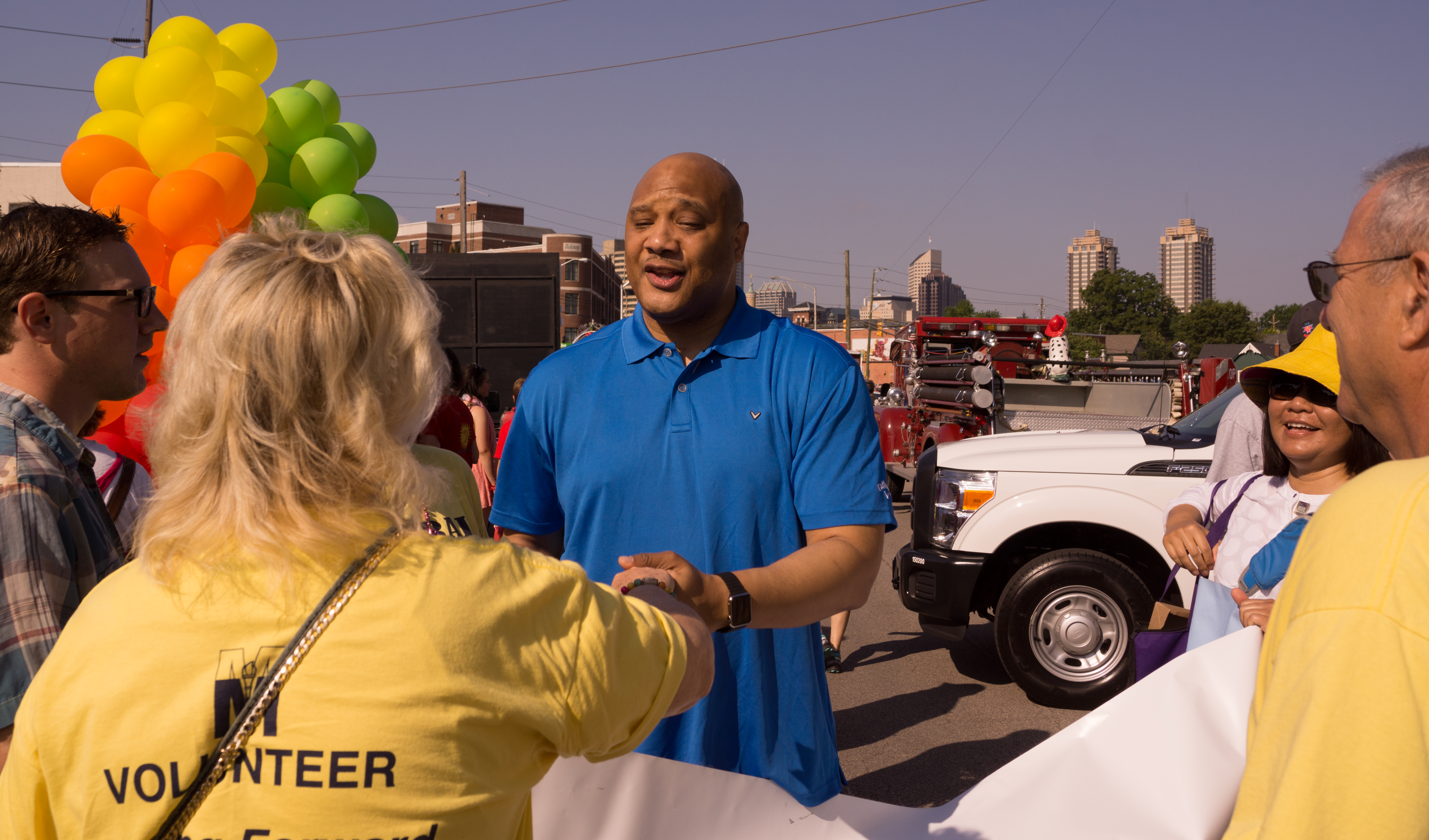

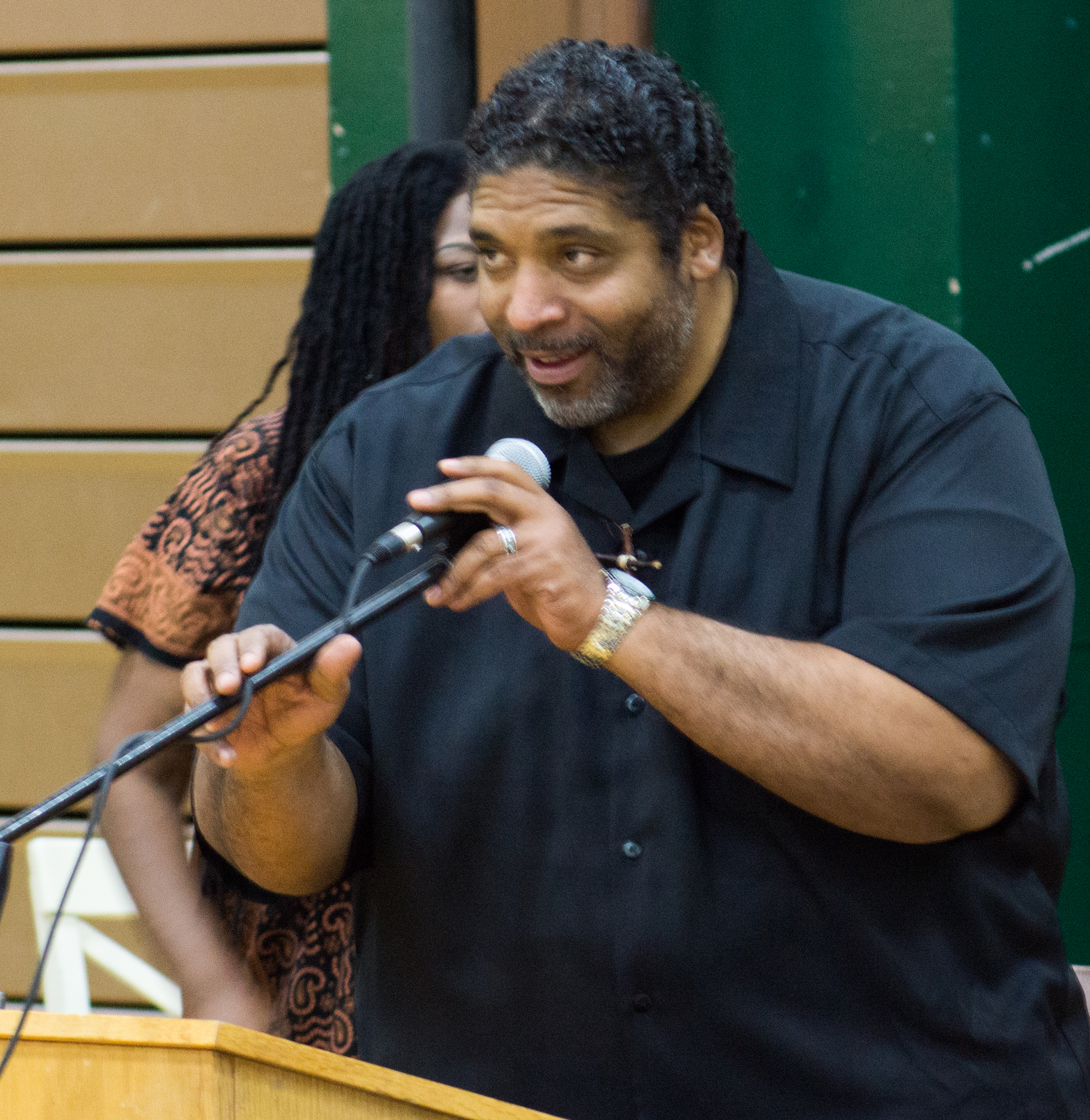
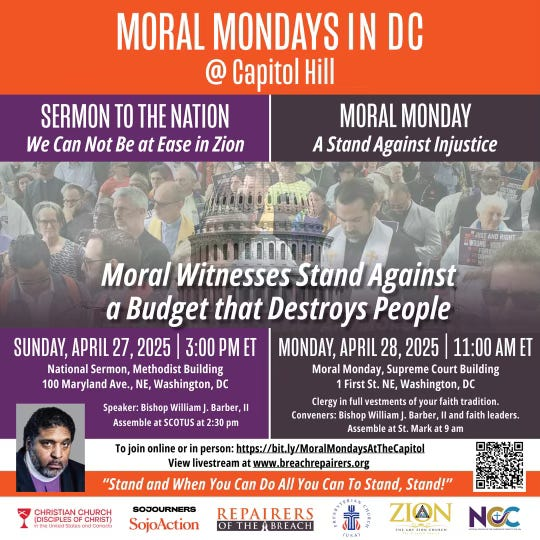
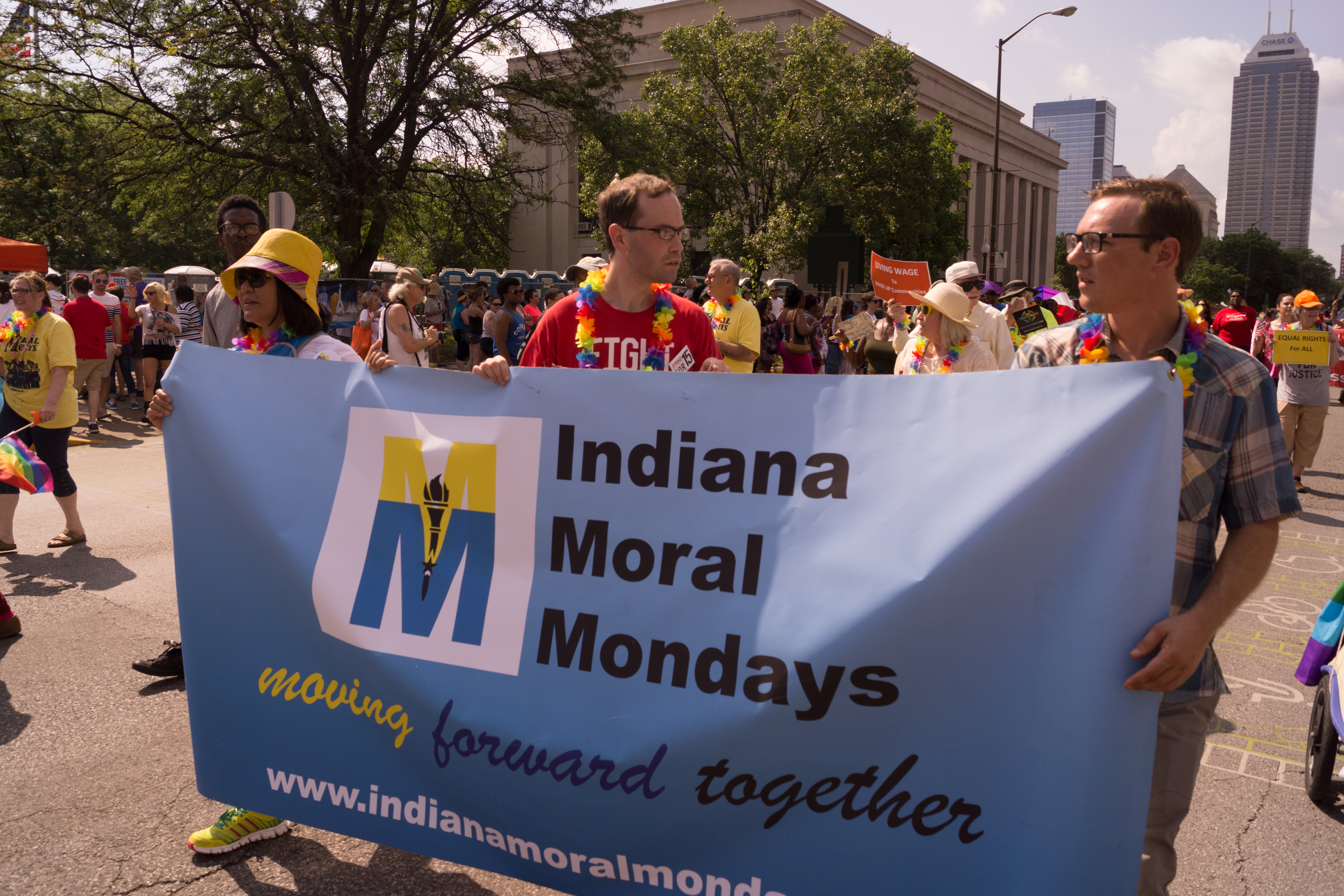
Photo credits: Jeff Kisling
 unflinching