Forgive Me, Gaza…
Jamal Kanj
Forgive me for my helplessness.
Forgive me for every sip of water, every bite of food, every breath I take while you suffocate.
Forgive me, if those I met in Gaza years ago ever thought I’d forgotten them.
Forgive me if I couldn’t help everyone who asked.
Forgive my comfort.
Forgive my peace.
I seek not your absolution—
Only that you know:
You are not forgotten.
Author and thinker Chris Hedges has been publishing nearly daily articles about the genocide of Palestinians. Using Google’s NotebookLM that I’ve been writing about, what follows are various ways to explore his recent writings.
Podcast
This is an audio overview of those articles.
Mind Maps
Another research tool of NotebookLM is the ability to create mind maps, showing relationships among concepts. This is an overview of Palestine and the Politics of Dehumanization/Empire.
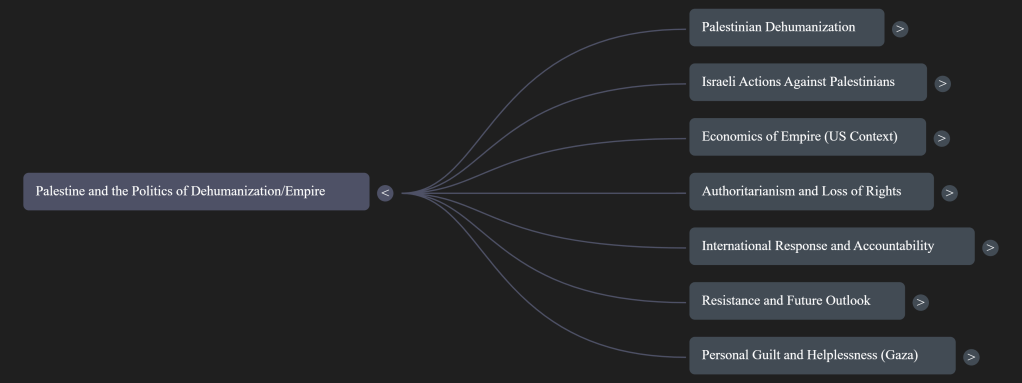

The first concept, Palestinian Dehumanization, has the following branches:
Demand for Perfect Victims
Mohammed el-Kurd is a Palestinian writer and poet who defines this concept in his new book, ““Perfect Victims: And the Politics of Appeal.” He joins host Chris Hedges on this episode of The Chris Hedges Report to share the ways in which Palestinians must bog down their identities, even in the midst of the genocide in Gaza, to crack through the limited and racist perspectives of Western audiences.
The sources extensively discuss the demand for Palestinians to conform to the role of “perfect victims” within Western narratives, and how this demand is deeply intertwined with the dehumanization of Palestinians
Chris Hedges Report: Perfect Victims And The Politics Of Appeal by Chris Hedges, Scheer Post, March 13, 2025
Author’s Note
- I have said too much and too little about the subject of this work, which is, even beyond the Palestinian question, a subject referred to by many names and already discussed at great length. This book is my humble attempt at presenting my argument coherently and comprehensively, though it remains, for all intents and purposes, an incomplete work. It is not only grief that makes writing in the time of genocide a torturous task; it is, more so, one’s recognition of the written word as shamefully insufficient in the face of 2,000-pound bombs.
- Our history’s bloodiest chapter, one must admit, has accentuated a morbid correlation that has long existed: the more martyrs there are, the more podiums. There is no denying that the Palestinian in the West and many parts of the Arab world confronts staggering levels of violence, suppression, and erasure. However, within certain progressive niches in media, culture, academia, and politics, “Palestine” is emerging as a social currency for certain individuals. One’s responsibility here, and the least that anyone can do, is to raise the ceiling of what is permissible.
- No assessment of a “politics of appeal” can be written without first recognizing that today’s world is unlike yesterday’s. Our people have sacrificed and struggled artfully to work within and around an unworkable system. While I may often complain about the discursive nature of our battles, I cannot forget that not very long ago we barely existed in any mainstream discourse. It is tempting to continue this thought by saying our civil society infrastructure today dwarfs that of the past, that our late revolutionaries and intellectuals were surveilled, silenced, and suppressed with a brutality that has since fallen out of favor. But Gaza nullifies such a reading. I do not want us to compare our past to our present. I want us to invent a new future, to break out of the hamster wheel.
El-Kurd, Mohammed. Perfect Victims: And the Politics of Appeal (pp. 9-10). Haymarket Books. Kindle Edition.
Guilt by Birth Narrative
The sources discuss the “guilty by birth” narrative in the context of Palestinian dehumanization, highlighting how Palestinians are inherently viewed with suspicion and often presumed guilty simply by existing1 . Mohammed El-Kurd explicitly states, “It is almost simplistic to say we are guilty by birth. Our existence is purely mechanistic; we are reminded, through policy and procedure, that we are unfortunately born to die”1 . This statement encapsulates the essence of the “guilty by birth” narrative applied to Palestinians.
Suppressed Palestinian Speech
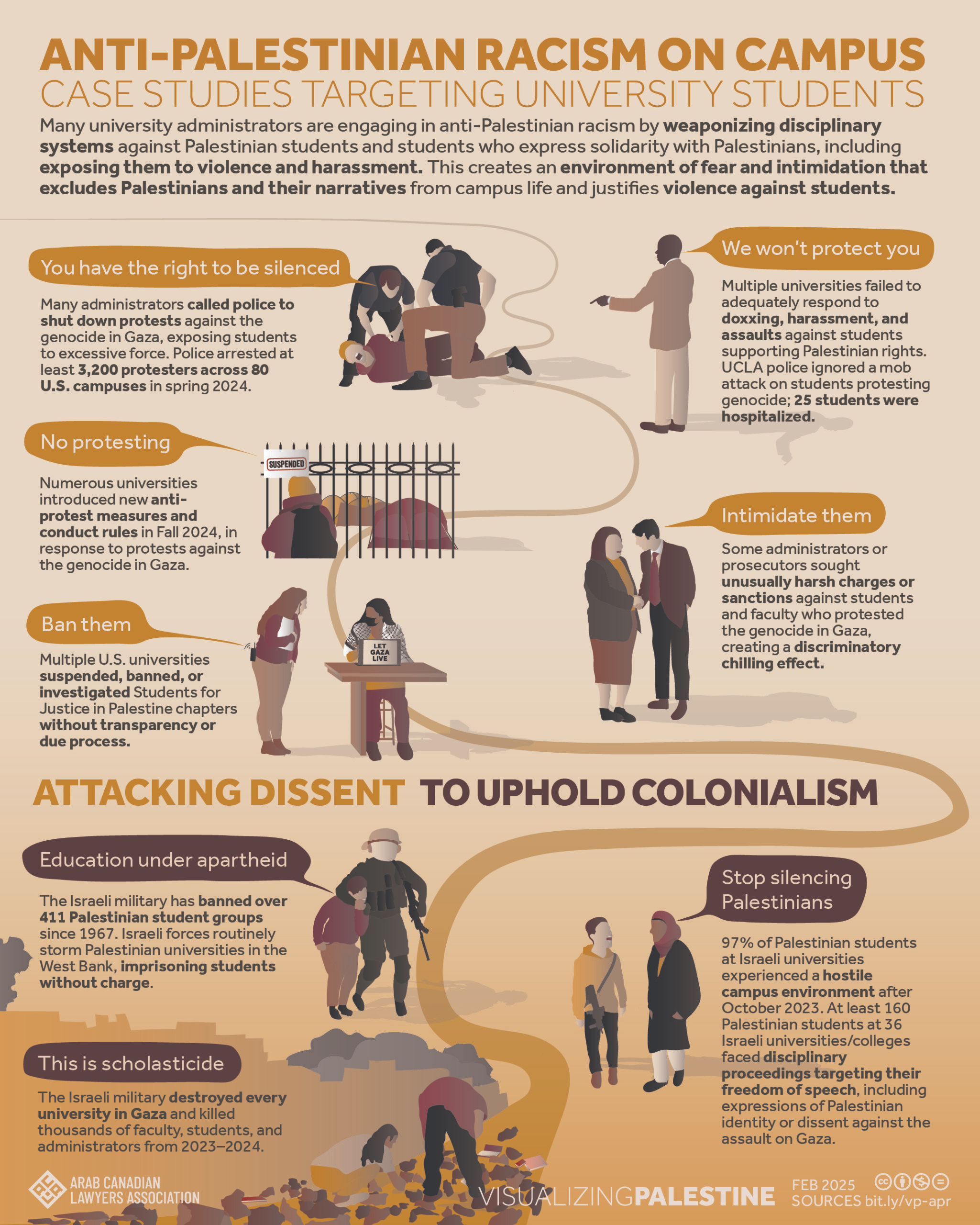
The sources offer a powerful and consistent narrative about the suppression of Palestinian speech as a critical component of their larger dehumanization. Mohammed El-Kurd, in his interview about his book “Perfect Victims: And the Politics of Appeal,” serves as a central voice articulating this suppression1 ….
According to El-Kurd and Chris Hedges, any account of the occupation from a Palestinian perspective is immediately expected to be refined to appeal to Western pathos, often curating their stories into a “digestible format” that sacrifices crucial truths
Internalized Oppression
In essence, the sources illustrate how the sustained dehumanization of Palestinians leads to a significant degree of internalized oppression. They are forced to constantly navigate a world that views them with suspicion, demands they conform to impossible standards of victimhood, and often denies their basic humanity. This creates a psychological burden, leading to self-censorship, a language of self-reproach, and a potential internalization of the very narratives used to oppress them
Unequal Standards (Ukraine Example)
The sources highlight a stark contrast in the way Palestinian resistance and suffering are viewed and reported compared to the situation in Ukraine, illustrating unequal standards that contribute to the dehumanization of Palestinians.
Mohammed El-Kurd explicitly discusses this double standard in his interview with Chris Hedges. He points out that while Ukrainian resistance against Russian invasion is often “lionized,” this same valorization is absent when it comes to Palestinian resistance against Israeli occupation.
Media Bias
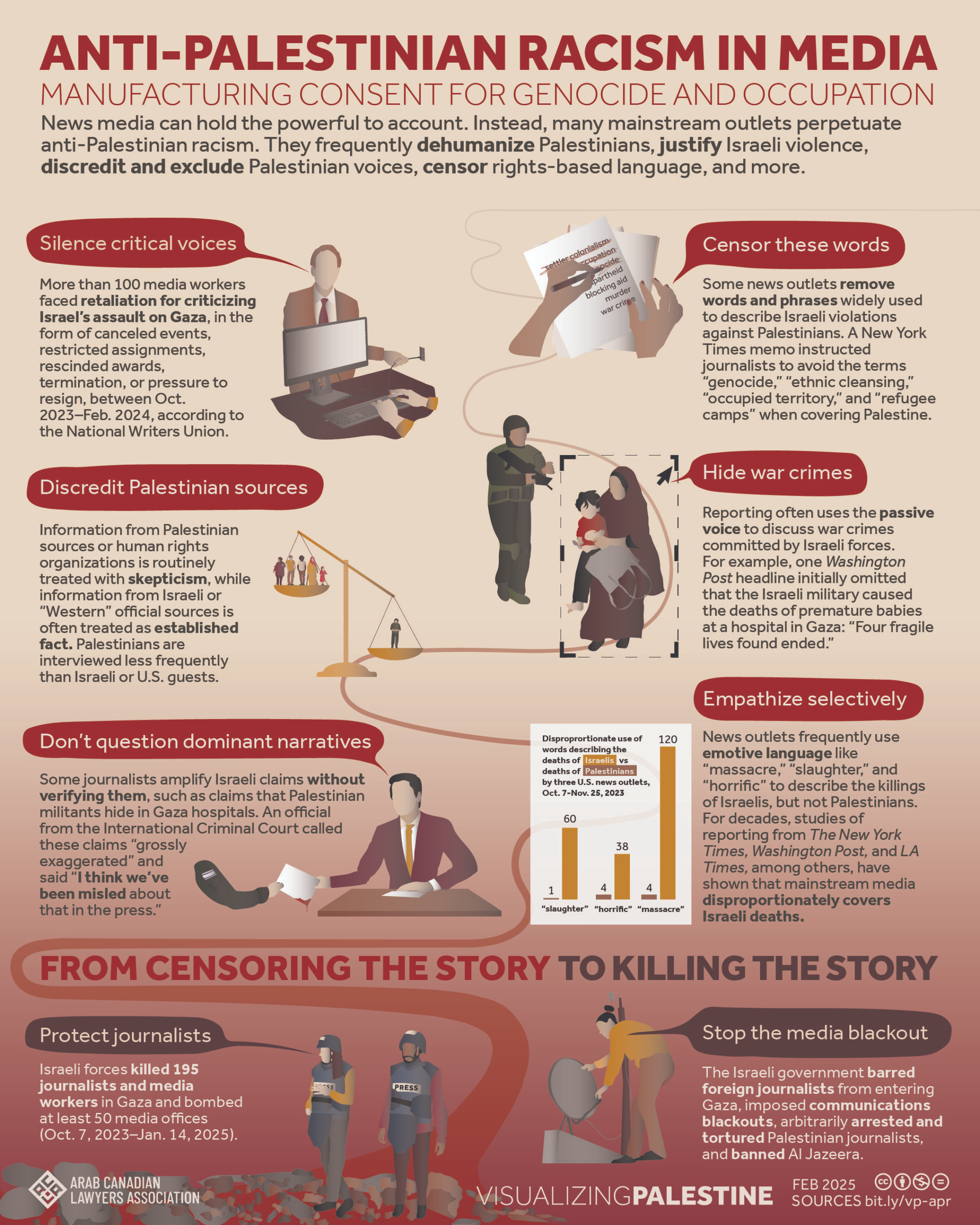
The sources extensively discuss media bias and its significant role in the larger context of Palestinian dehumanization. They argue that the way Palestinians and the Israeli-Palestinian conflict are portrayed in Western media often serves to dehumanize Palestinians by conditioning support for them, obscuring the root causes of their suffering, and denying them agency.
Here are the key points from the sources about media bias and Palestinian dehumanization:
- Conditional Sympathy and the “Perfect Victim” Trope: The sources emphasize that positive support for Palestinians in Western media is often conditional.
- Self-Censorship and the Suspicious Audience: El-Kurd argues that Palestinians write and speak to a Western audience that is inherently “suspicious” of them. This leads to self-censorship, where they “draft your eulogies as if they are addressed to people who are eager to indict you” . This internalized pressure to conform to a certain narrative and avoid condemnation is a direct consequence of dehumanizing media portrayals that constantly question Palestinian legitimacy and humanity.
- El-Kurd highlights the stark contrast in media treatment between Palestinian and Israeli narratives. He recounts an experience where an ABC News anchor offered condolences to an Israeli guest immediately after interviewing him, but offered no such sentiment to El-Kurd. This differential treatment signifies a dehumanization of Palestinian suffering.
- Passive Voice and Obfuscation of Responsibility: El-Kurd critiques the media’s use of passive voice when reporting on Palestinian deaths, stating that “correspondents kill us with passive voice”. This linguistic choice obscures the culpability of the perpetrators and normalizes Palestinian suffering, contributing to their dehumanization.
- Mischaracterization of Palestinian Resistance: The sources contrast the often-positive portrayal of Ukrainian resistance with the demonization of Palestinian resistance. El-Kurd notes examples of Western media glorifying Ukrainian civilians engaged in fighting while similar actions by Palestinians are labeled as terrorism. Chris Hedges recalls how pacifism was not discussed during the siege of Sarajevo, yet it is often expected of Palestinians facing occupation.
- Ignoring the Root Causes: Focus on Occupation, Not Zionism: El-Kurd suggests that some well-meaning media and organizations focus on the “occupation” as the cause of the conflict but fail to address Zionism as a “racist, expansionist, ideologically driven movement of Jewish supremacy”. By not tackling Zionism at its root, the media narrative can inadvertently dehumanize Palestinians by presenting their suffering as solely a consequence of military occupation rather than a result of a deeper ideological project of displacement and erasure
- Media’s Role in Enabling Continued Violence: Finkelstein argues that Israel strategically times its military actions to coincide with other major world events to avoid media scrutiny. He suggests that the intense media focus on Donald Trump has provided Israel with an opportunity to intensify its actions in Gaza with less international attention. The withdrawal of media attention effectively allows for the continuation of violence and dehumanization without significant external pressure.
- Normalization of Palestinian Suffering: The constant exposure to reports of Palestinian deaths and suffering, often framed within biased narratives, can lead to a normalization of this violence. El-Kurd reflects on his own disturbing reaction to news of Palestinians being “burnt alive,” highlighting a tendency to exceptionalize certain atrocities while implicitly accepting others. This normalization is a significant indicator of dehumanization.
















 unflinching