
Filed hours before his killing in an Israeli airstrike, journalist Hossam Shabat describes the resumption of Israel’s scorched earth campaign in his hometown of Beit Hanoun.
Hossam Shabat is dead. I am beyond rage and despair as I write these words. The Israeli military bombed his car this morning as he was traveling in Beit Lahia. Videos fill my screen of his body lying on the street, carried to the hospital, grieved by his colleagues and loved ones. These are the kinds of tragic scenes Hossam himself would so often document for the world. He was an exemplary journalist: brave, tireless, and dedicated to telling the story of Palestinians in Gaza.
Hossam was one of a handful of reporters who remained in northern Gaza through Israel’s genocidal war. His ability to cover one of the most brutal military campaigns in recent history was almost beyond comprehension. He bore witness to untold death and suffering on an almost daily basis for seventeen months. He was displaced over twenty times. He was often hungry. He buried many of his journalist colleagues. In November, he was wounded in an Israeli airstrike. I still can’t believe I am referring to him in the past tense. Israel obliterates the present.
His writing was lyrical and arresting. I struggled to translate and edit his pieces—to do them justice, to convey his emotive use of Arabic into something relatable in English. In the typical editorial see-saw back and forth of finalizing a piece, I would often return to him with clarifications and questions, asking him for additional details and direct quotes. He was always quick to respond despite his extraordinary circumstances.
…
He messaged me late Sunday night, just hours before he was killed. He had been forced to leave his hometown of Beit Hanoun on the day of Israel’s renewed assault last week and was forcibly displaced yet again—this time to Jabaliya. We had agreed on him writing a piece about the attack last week and what he had witnessed.
“Habibi,” he wrote. “I miss you.” I asked him what the situation was like in Jabaliya. “Difficult,” he said.
He sent his piece, and I read through it, sent my follow-up questions. He only answered one before going offline. I messaged him again as soon as I woke up this morning. I didn’t yet know that he had been killed.
What you are about to read is Hossam’s last article. I translated it through tears.
—Sharif Abdel Kouddous
Hossam Shabat’s Last Article. Filed hours before his killing in an Israeli airstrike, journalist Hossam Shabat describes the resumption of Israel’s scorched earth campaign in his hometown of Beit Hanoun translated by Sharif Abdel Kouddous, Drop Site News, Mar 25, 2025
Report from the Frontline of Israel’s War of Annihilation
Story by Hossam Shabat
BEIT HANOUN, GAZA—The night was dark and cautiously quiet. Everyone fell into an anxious sleep. But the tranquility was quickly shattered by deafening screams. As the bombs rained down, the wails of neighbors announced the first moments of the resumption of Israel’s military campaign. Beit Hanoun was plunged into panic and terror. Cries of distress rose amid the screech of the shells in a scene that reflected the magnitude of the disaster engulfing the city. This was only the beginning. The massacre of entire families quickly followed. Columns of smoke rose everywhere. The bombing did not cease for a moment, drowning everything in a relentless hail of fire and suffering.
The Israeli attack is continuing. The occupation is practicing its brutality with unprecedented bombardment leaving behind horrific scenes of destruction and bloodshed. According to the United Nations Office for the Coordination of Humanitarian Affairs, the number of martyrs over the past six days has topped 700, reflecting the degree of such immense human suffering. OCHA also reports how Gaza is suffering from a severe shortage of medicines and medical aid, exacerbating an already dire situation.
In the first six days of this renewed military operation, northern Gaza witnessed four bloody massacres. The most notable was the Mubarak family massacre, which took place as the family was gathering in mourning to offer their condolences to Dr. Salim Mubarak. In an instant, their collective grieving was turned into a sea of blood and body parts. The entire family was killed: Dr. Salim, his wife, his children, his parents. No one survived. One eyewitness summed it up plainly: “They were all killed.” The victims were not on a battlefield but in a house of mourning. It was a crime in every sense of the word.
This massacre was not the only one—it was followed by successive attacks on other families, including the Abu Nasr family, then the Abu Halim family—bringing to mind the vicious bombardment in the very beginning of the war after October 7. The aggression is ongoing, relentless, targeting innocent civilians indiscriminately, leaving behind only destruction and death.
When I arrived on the scene, I wasn’t ready for the horror before my eyes. The streets were filled with the dead. Under every stone lay a martyr. Dozens were crying for help from underneath the rubble of their homes but there was no one to respond. Screams filled the air while everyone stood helpless. My tears didn’t stop. The scenes were more than any human being could bear. The ambulances were filled with corpses, their bodies and limbs piled on top and intertwined with one another. We could no longer distinguish between children and men, between the injured and the dead.
At Al-Andalus hospital the scene was even more painful. The hospital was filled with martyrs. Mothers bid silent farewells to their children. Medical staff worked in horrific conditions, trying to treat the injured with only the most basic means available. It was an impossible situation with massive numbers of dead and wounded being brought in at a terrifying rate.
Israel’s aggression continues. Massacre after massacre, leaving only the screams of mothers in its wake and the dreams of children that have turned to ash. There is no justification for this. Everything is being crushed: the lives of innocent people, their dignity, and their hopes for a better future.
* Translation by Sharif Abdel Kouddous
Hossam’s last message was: “I ask you now: do not stop speaking about Gaza. Do not let the world look away. Keep fighting, keep telling our stories—until Palestine is free.”
Statement from Drop Site News on Israel’s Murder of Our Colleague Hossam Shabat: We Hold Both Israel and the U.S. Government Responsible
Today, March 24, 2025, Israel killed journalist Hossam Shabat, a reporter for Al Jazeera Mubasher and a contributing reporter to Drop Site News, in what witnesses described as a targeted strike. Hossam was a tremendous young journalist who exhibited remarkable courage and tenacity as he documented the U.S.-facilitated genocide against the Palestinians of Gaza. One of the few journalists who didn’t leave the northern Gaza Strip, Hossam was murdered in Beit Lahia, the site of some of the most intense Israeli bombing and mass killing operations.
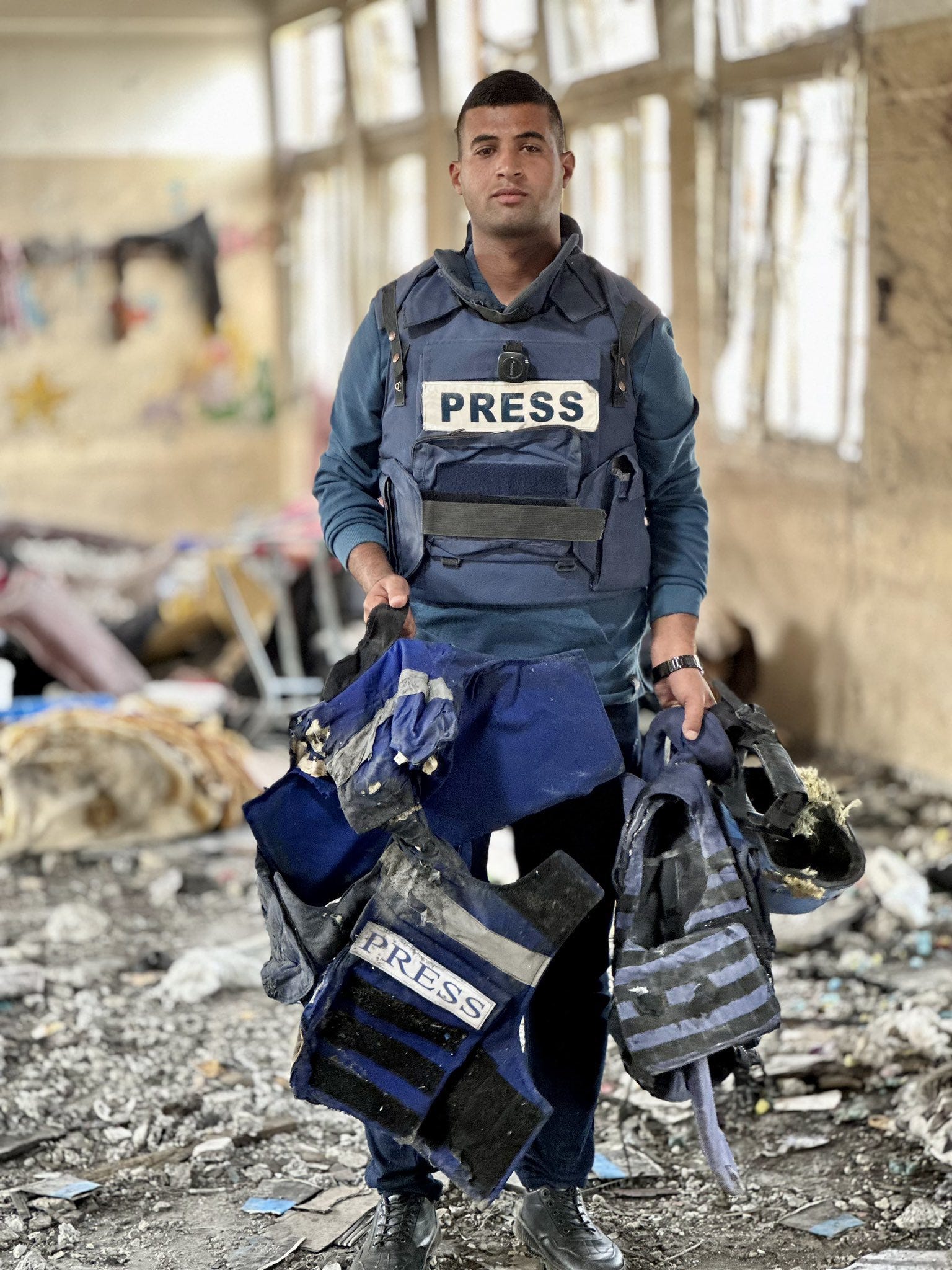
Drop Site News holds Israel and the U.S. responsible for killing Hossam. The journalist Mohammad Mansour, a correspondent for Palestine Today, was also killed Monday in an Israeli attack on a house in Khan Younis in southern Gaza. More than 200 of our Palestinian media colleagues have been killed by Israel—supplied with weapons and given blanket impunity by most Western governments—over the past seventeen months.
“If you’re reading this, it means I have been killed—most likely targeted—by the Israeli occupation forces,” Hossam wrote in a statement posted posthumously by his friends on his social media accounts. “For [the] past 18 months, I have dedicated every moment of my life to my people. I documented the horrors in northern Gaza minute by minute, determined to show the world the truth they tried to bury. I slept on pavements, in schools, in tents—anywhere I could. Each day was a battle for survival. I endured hunger for months, yet I never left my people’s side.”
Hossam, who was just 23, filed poetic and painful dispatches from Gaza. He never separated himself from the people whose lives and deaths he documented. “Time now is measured not in minutes, but in lifetimes of pain and tears” as people in Gaza waited for the implementation of the ceasefire, Hossam wrote in an article for Drop Site in January. “With every passing moment the anxiety and tension of the people here grows, as they wonder whether they will stay alive long enough for the fire to cease.”
As Palestinian journalists in Gaza continue to document the genocide against their families and their people, most of the world encounters their work only through their video reports on social media. They are so much more than those videos. Hossam was born into a period of escalating Israeli annexation, siege, and genocide. Unflagging in the face of constant deprivation and violence, Hossam once summarized his life’s dedication in an interview: “I say to the world, I am continuing. I am covering the events with an empty stomach, steadfast and persevering. I am Hossam Shabat, from the resilient northern Gaza Strip.”
Hours before he was killed, Hossam filed a story for Drop Site about Israel’s resumption of its scorched earth bombing of Gaza last week that killed over 400 people, including nearly 200 children in a matter of hours. He was eager to publish. “I want to share the text urgently,” he wrote in Arabic. He always wanted to get the story out—to report what was happening on the ground. About a year ago, Hossam wrote, “Before this genocide started, I was a young college student studying journalism. Little did I know I would be given one of the hardest jobs in the world: to cover the genocide of my own people.”
In October 2024, the Israeli military placed Hossam and five other Palestinian journalists on a hit list. Hossam regularly received death threats by call and text. What we have witnessed for nearly a year and a half is the Israeli military engaging in a systematic campaign to kill Palestinian journalists, as well as members of their families. Hossam leaves behind his beloved mother and his people, whose lives he tirelessly worked to represent and protect.
During this unprecedented killing campaign against journalists, the silence of so many of our colleagues in the Western media is a stain on the profession. The International Federation of Journalists has put out a list, by name, of many of the journalists and media workers who have been killed or injured in Gaza. In a just world, those who helped to kill Hossam—and all of our Palestinian colleagues—would be brought to justice and tried for their crimes. We call on all journalists to raise their voices to demand an end to the killing of our Palestinian colleagues who have risked, and often given, their lives so that the truth itself can live.
Hossam’s last message was: “I ask you now: do not stop speaking about Gaza. Do not let the world look away. Keep fighting, keep telling our stories—until Palestine is free.”
Statement from Drop Site News on Israel’s Murder of Our Colleague Hossam Shabat: We Hold Both Israel and the U.S. Government Responsible, Drop Site News, Mar 24, 2025

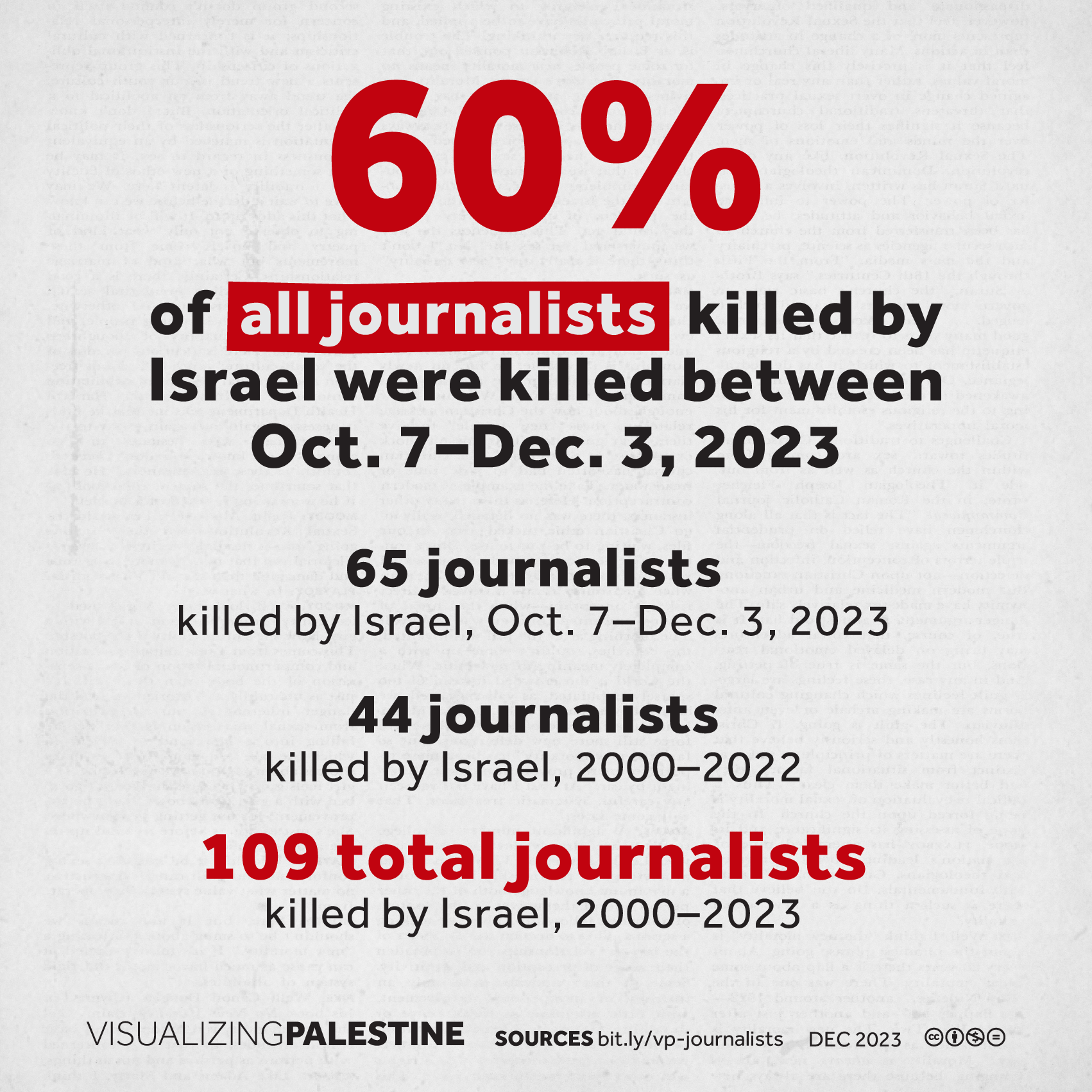
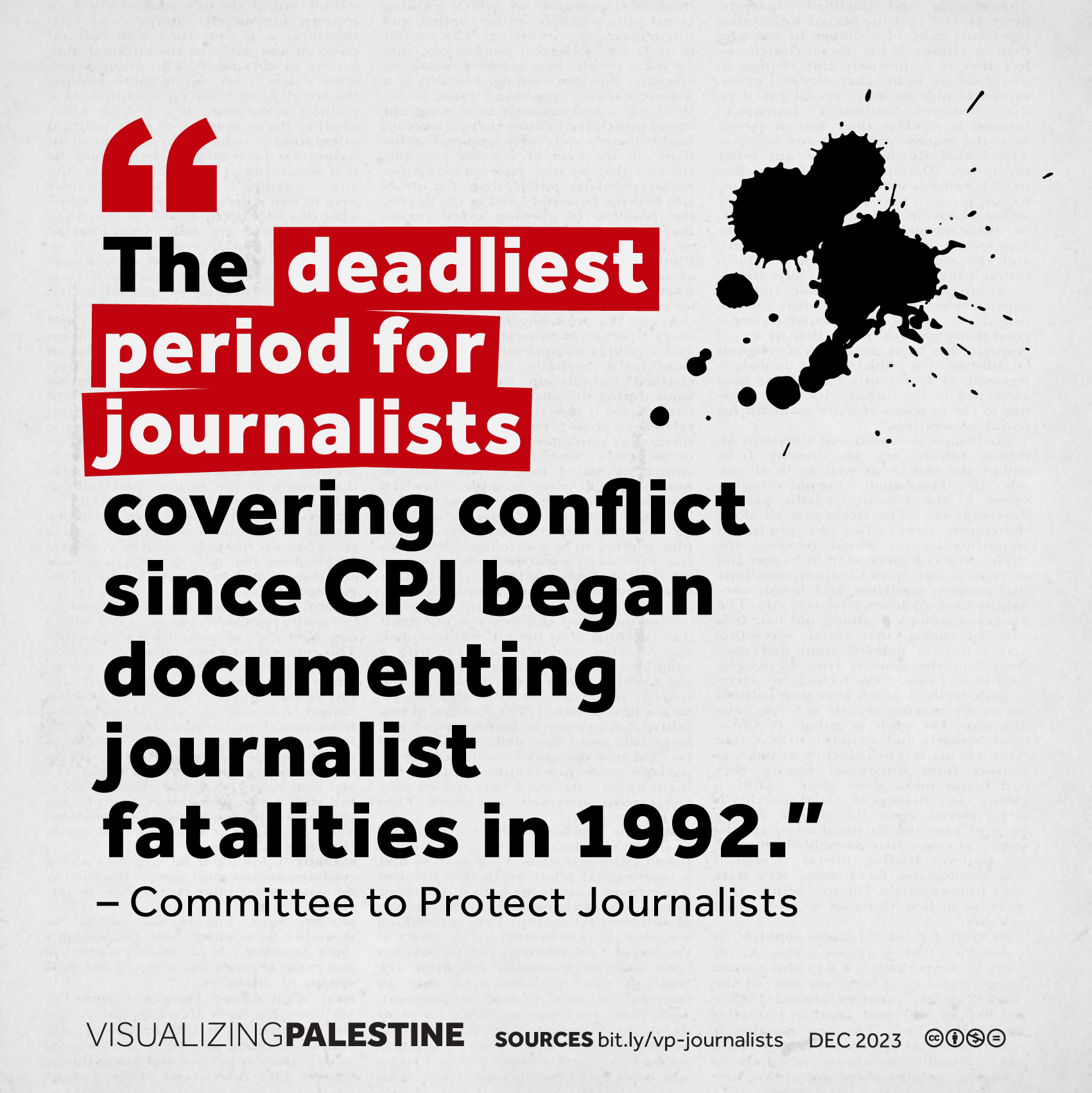
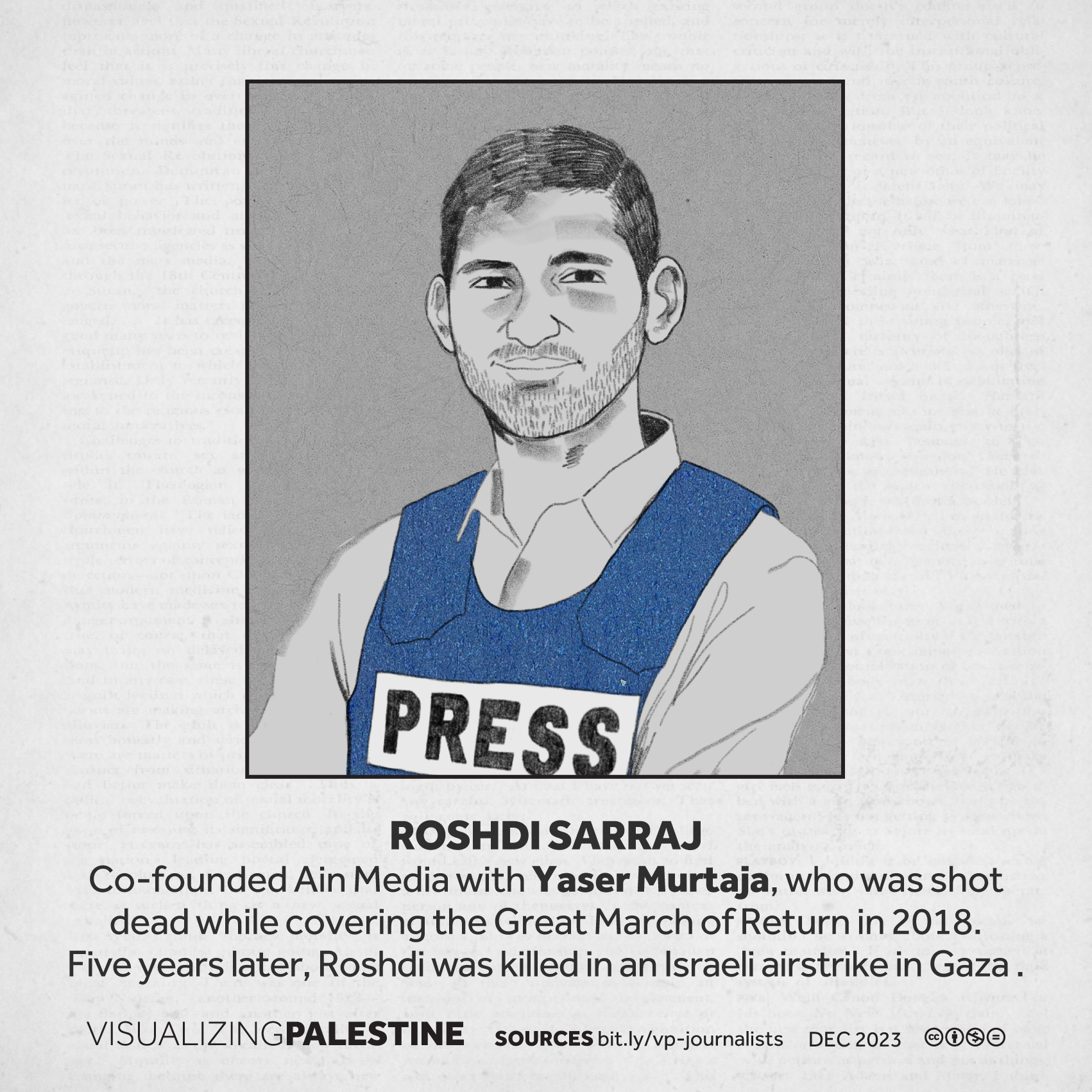
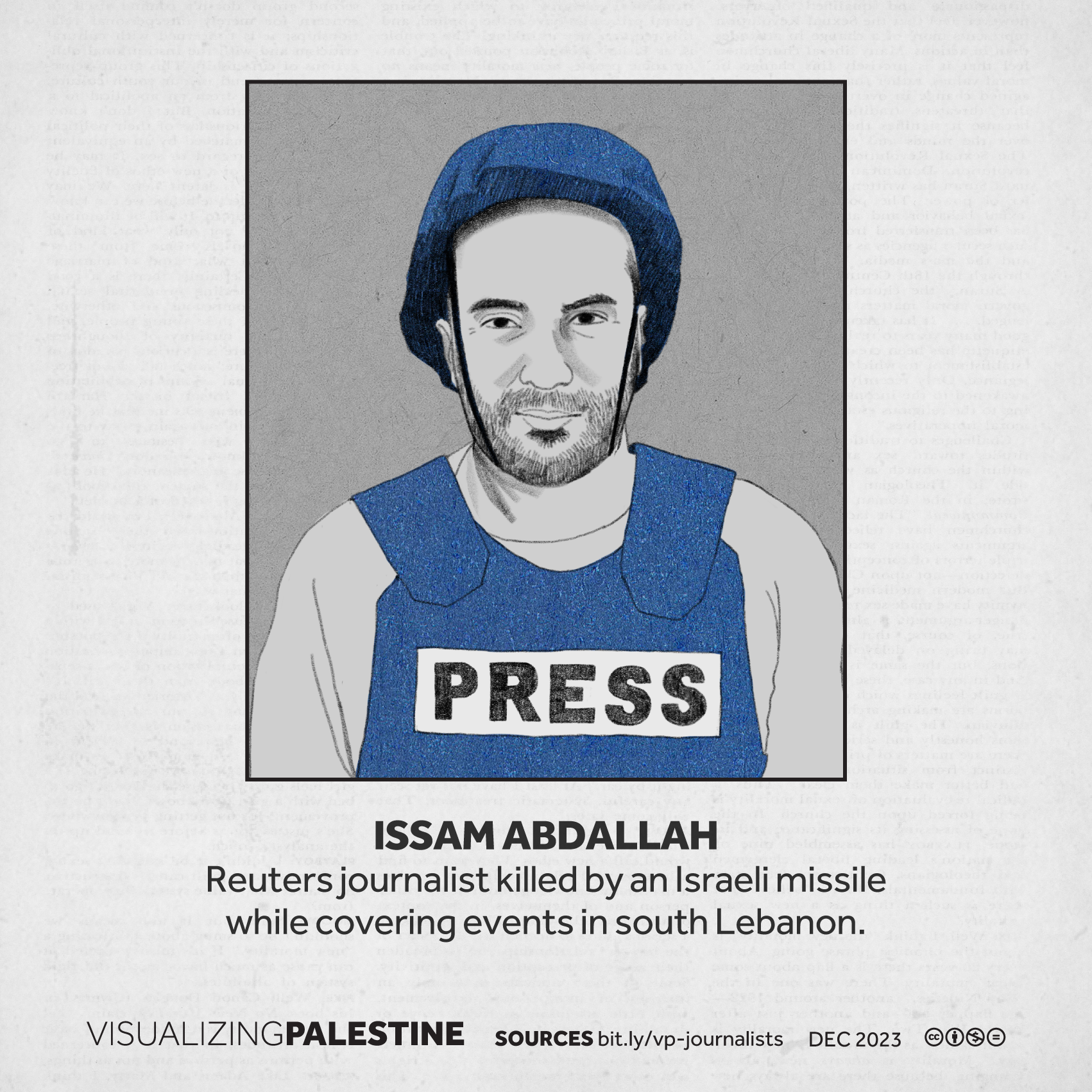
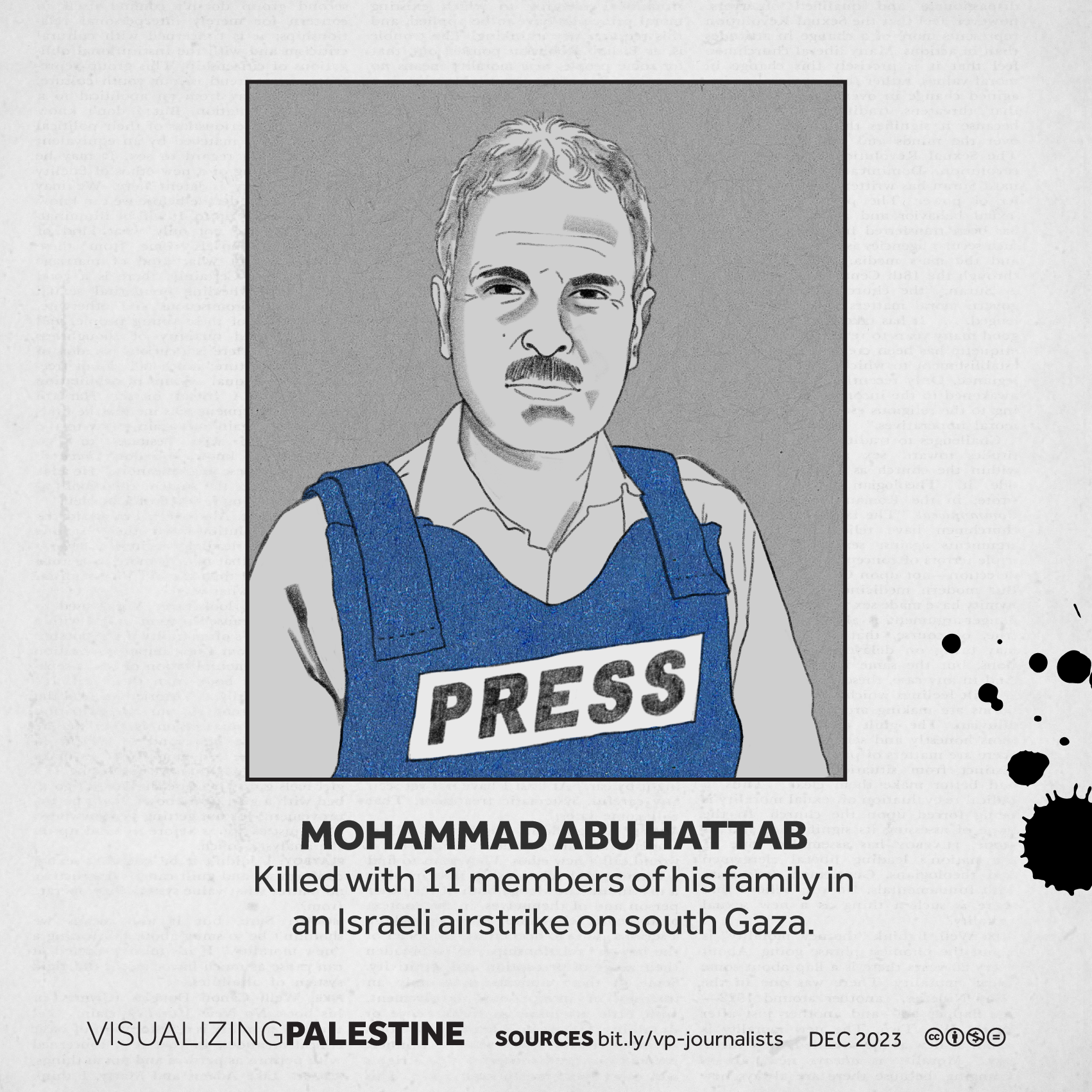
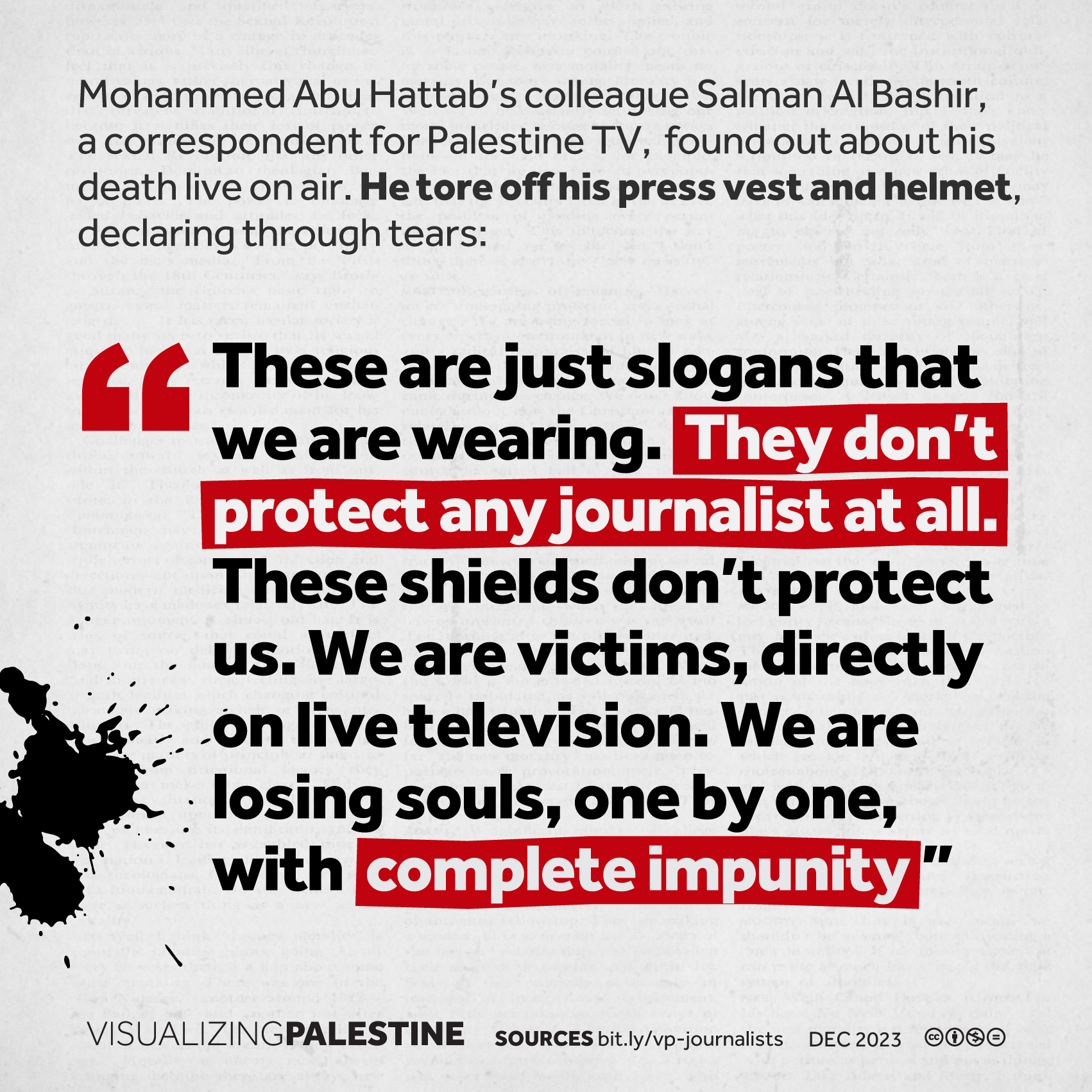
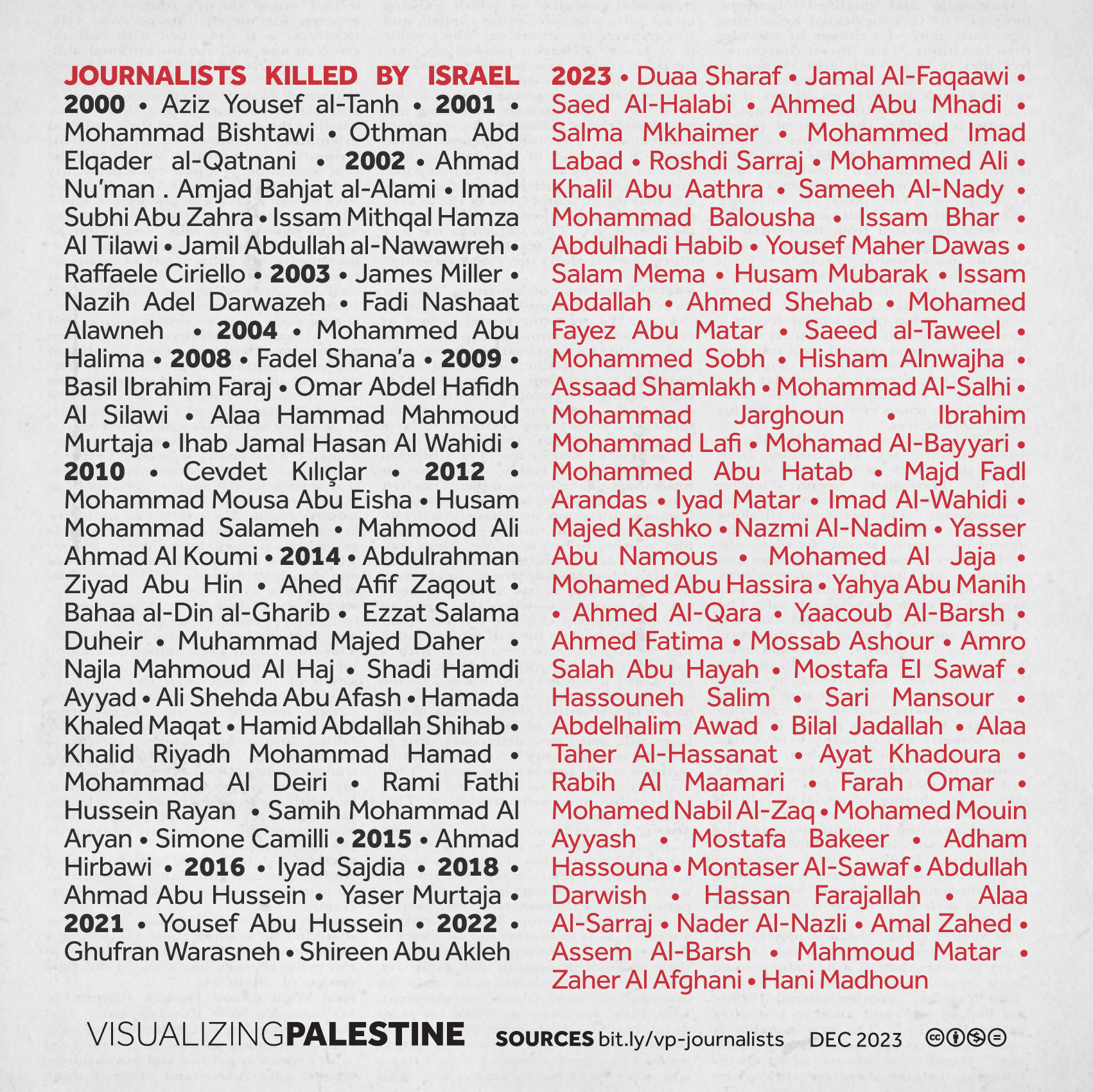
The ongoing Israeli bombardment of Gaza, which started in October 2023, has been described as the deadliest period for journalists. 53% of all journalists killed by Israel between 2000-2023 were killed during Israel’s current assault on Gaza. Journalists in Gaza are finding it more difficult to report Israeli atrocities due to prolonged periods of communication blackouts. With 48 media facilities in Gaza hit or destroyed, Israel is committing a genocide under a complete media blackout.
You can see a spreadsheet of the data these infographics are based on here: https://bit.ly/vp-journalists

 unflinching