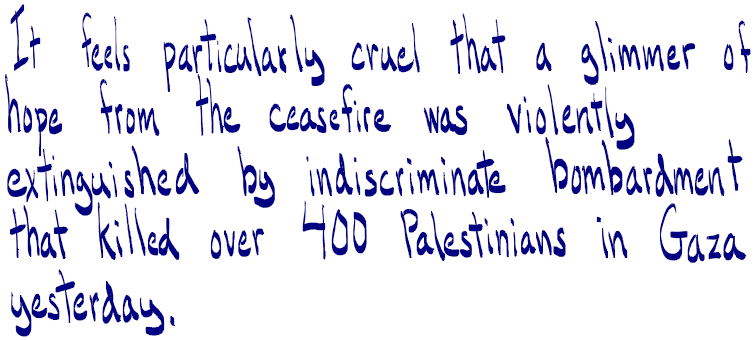
Despite the temporary nature of the recent ceasefire and the grim conditions of destruction, blockade and famine, this year I had a glimmer of hope. Now, with the brutal return of genocide, my feelings of despair have deepened.
Dalia Abu Ramadan

During the 2 am bombardment, the earth itself seemed to shake under the force of each blast. Fear gripped my heart, and my family and I scrambled to make sense of the chaos. What was happening? We were paralyzed by the shock, as if we were reliving the horror of war all over again. We couldn’t believe it. Had the war truly returned?
In disbelief, we reached out to friends and turned on the news, desperate for answers. The response was clear — yes, the Israeli military’s airstrikes had resumed, raining down across Gaza from north to south. Death has returned like a shadow that followed us. Today is not October 7, but this is the same nightmare in a different moment, a different hour, a different year. New questions haunt us: Will this nightmare stretch beyond a year, like the war did before this broken ceasefire, or will we be consumed from the very beginning? Will this Ramadan mirror the one we barely survived? Will it bring more sorrow, more despair, as we find ourselves trapped in a cycle that refuses to end?
Despite the temporary nature of the recent ceasefire and the grim conditions of destruction, blockade and famine, this year I had a glimmer of hope. Now, with the brutal return of genocide, my feelings of despair have deepened.
Israel’s Bombs Rained Down at 2 am, Killing Hundreds Around Me in Gaza. The ceasefire was still difficult, but we believed we would wake up alive. Now, Israel has taken even that away from us. By Dalia Abu Ramadan, Truthout, March 18, 2025

| We are outraged at Israel’s continued impunity. Last night, Israel killed more than 400 Palestinians in a massacre intended to destroy the ceasefire for good. This is not the first time that Israel has tried to upend the agreement. Over the last two months, Israel has killed hundreds of Palestinians, blocked aid shipments, and refused to participate in talks on the next phase of the ceasefire. This is the sixth time we update this visual with figures on Israel’s wanton destruction of Gaza and genocide against Palestinians since October 2023. We used data from the United Nations Office for the Coordination of Humanitarian Affairs (OCHA) and Al-Jazeera to update this visual. According to a report released by The Lancet in July 2024, the estimates of Palestinians killed is much higher than the figures included in this visual. As we grieve this continued devastation and loss, we must not be intimidated into silence. We must continue to push for Israel to be held accountable for its crimes, and demand an arms embargo now. In solidarity, The VP team |
The facts
- Israel’s renewed bombardment has killed at least 400 Palestinians since dawn Tuesday and injured more than 500 others, according to Gaza’s Health Ministry, which said efforts to recover people under the rubble are ongoing. Strikes were reported across the enclave, from Khan Younis in the south to Gaza City in the north.
- Hamas accused Israel of reneging on the ceasefire agreement, but there has been no immediate sign of the militant group retaliating against the Israeli strikes.
- Israel said resuming its bombardment was the only way to secure the release of the remaining hostages held in Gaza, after it blamed Hamas’s rejection of mediation proposals for the stalling of ceasefire negotiations.
- White House press secretary Karoline Leavitt told Fox News’s Sean Hannity that Israel had consulted the United States about the strikes.
- More than 48,000 people have been killed in Gaza during the war and more than 112,000 injured, according to the Gaza Health Ministry, which does not distinguish between civilians and combatants. Israel estimates that about 1,200 people were killed in Hamas’s Oct. 7, 2023, attack, including more than 300 soldiers. It says 407 soldiers have been killed in its military operation in Gaza.
Israel broke its ceasefire with Hamas in Gaza. What happened? After negotiations for Phase 2 of Israel and Hamas’s ceasefire deal failed to materialize, Israel said the strikes were necessary to free remaining hostages. By Leo Sands, Victoria Bisset and Shira Rubin, The Washington Post, March 18, 2025




 unflinching