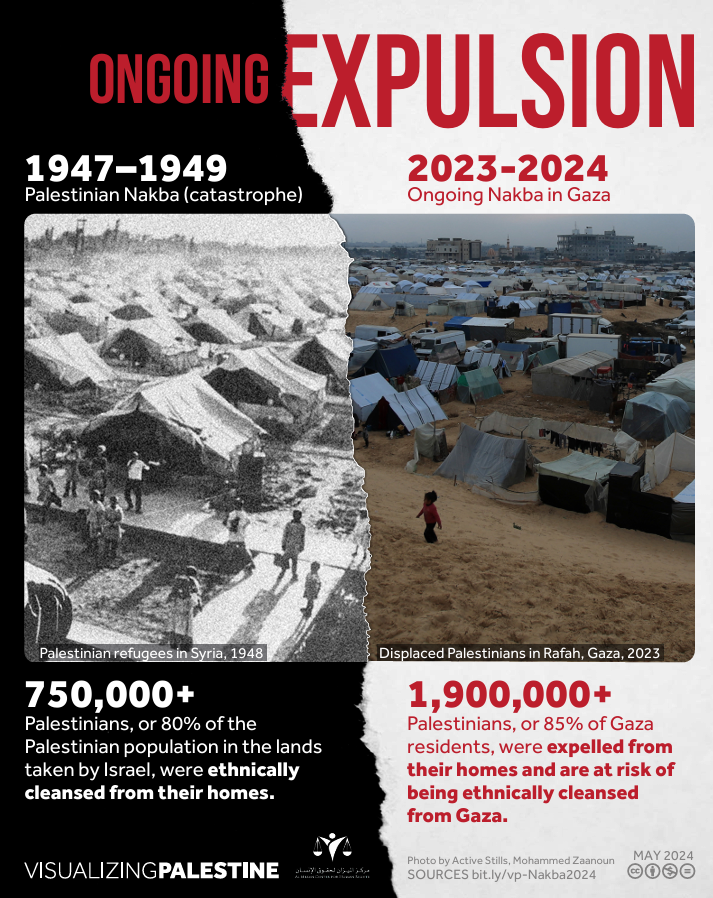
The Nakba (Arabic: ةَب ْكَّنلا an-Nakba, lit. ’the catastrophe’) was the ethnic cleansing of Palestinians in Mandatory Palestine during the 1948 Palestine war through their violent displacement and dispossession of land, property, and belongings, along with the destruction of their society, and the suppression of their culture, identity, political rights, and national aspirations. The term is also used to describe the ongoing persecution and displacement of Palestinians by Israel. As a whole, it covers the fracturing of Palestinian society and the long-running rejection of the right of return for Palestinian refugees and their descendants. Nakba Wikipedia
Ongoing Nakba
The most important long-term implications of the Nakba for the Palestinian people were the loss of their homeland, the fragmentation and marginalization of their national community, and their transformation into a stateless people.[184]
Since the late 1990s, the phrase “ongoing Nakba” (Arabic: النکبة المستمرة, romanized: al-nakba al-mustamirra) has emerged to describe the “continuous experience of violence and dispossession” experienced by the Palestinian people.[185] This term enjoins the understanding of the Nakba not as an event in 1948, but as an ongoing process that continues through to the present day.[186]
On November 11, 2023, Israeli Agriculture Minister Avi Dichter remarked in an interview on N12 News on the nature of the Israel–Hamas war that “From an operational standpoint, you cannot wage a war like the IDF wants to in Gaza while the masses are between the tanks and the soldiers,” he said. “It’s the 2023 Gaza Nakba.”[187]
“Since the start of their incursion, the Israeli occupation forces have been targeting homes and refugee shelters in Jabalia refugee camp, the beating heart of the city, clearly to put pressure on the inhabitants to run away,” explained Abu Wardeh. “However, most people persisted and stayed in their homes. We know that there is an Israeli plan to force us out of our land.”
Day after day, the Israeli occupation forces have targeted homes and refugee shelters alike, killing and wounding hundreds of people. The intensity of the bombardment meant that all rescue teams in the north had to suspend their services, including the Civil Defence and Ambulance teams.
Putting further pressure on Palestinian civilians to force them to leave, the occupation state has also targeted the three major hospitals in northern Gaza. Anyone seeking medical assistance and treatment has to go south to Gaza City.
Not content with dropping bombs and missiles on northern Gaza, said Abu Wardeh, the occupation forces have also used barrel bombs in the streets to displace the local population.
They detonate them without warning.
Palestinians Displaced From Northern Gaza Fear This New Nakba by Motasem A Dalloul, ZNetwork, 11/19/2024
For the first time, a U.S. president has dispensed with even the pretense of supporting a two-state solution.
President Trump’s latest remarks — proposing the forced displacement of Palestinians to Jordan, Egypt, and other Arab nations — should not just be noted as another inflammatory statement. They are the final nail in the coffin of a policy Washington has long claimed to uphold. His words make clear the two-state solution is dead, and Palestinian displacement isn’t a byproduct of American policy — it’s the goal.
The comments on the forced displacement of Palestinians from Gaza have rightly sparked shock and outrage for their blatant endorsement of ethnic cleansing, even as they are now being walked back and reframed as a mere humanitarian proposal.
What’s been lost in the coverage of Trump’s remarks is the deeper shift it signals: his proposal to occupy Gaza — whether permanently or not remains unclear — and relocate two million people to Egypt and Jordan isn’t just logistically impossible; it’s a declaration that Palestinian displacement is the goal, not the consequence, of U.S. policy.
Trump signals death knell of two-state solution. His plan for Gaza shows that no one really supports it, not the last administration or this one by Rawan Abhari, Responsible Statecraft, Feb 5, 2025
When I learned of the importance of the Nakba in the history of the Palestinian people, I took some time to research the subject, found here:




 unflinching