


But the past week’s trade policy showdown triggered outrage in Mexico and Canada. Spectators at National Hockey League and NBA games in Canada over the weekend booed the U.S. national anthem.


China swiftly retaliated Tuesday against President Donald Trump’s sweeping tariffs on Chinese imports with levies on U.S. goods, which are slated to take effect Monday. They include 15 percent tariffs on U.S. coal and liquefied natural gas (LNG), a slew of new export restrictions and an antitrust investigation into Google, according to the Chinese government.
A spokesperson for the Chinese Embassy in Washington described Beijing’s responses as “necessary countermeasures” that are “completely justified and reasonable,” while the Commerce Ministry called Trump’s tariffs “malicious in nature.”
Trump’s tariffs, which slap an additional 10 percent tax on all Chinese goods, went into effect after the United States and China did not strike a deal by 12:01 a.m. Eastern time Tuesday. China’s response further escalates trade tensions between the world’s largest economies.
China’s customs and tariff regulator announced the 15 percent tariffs on coal and LNG, as well as 10 percent levies on crude oil, agricultural machinery and some vehicles. Its Commerce Ministry announced export restrictions on materials such as tungsten, which is used in high-tech products, and sanctions on two U.S. companies.
Beijing has already previewed an aggressive playbook of retaliatory measures in recent months, including export controls, sanctions and antitrust investigations against U.S. companies and supply chains. The new Google investigation and the export restrictions are examples of those tools.
Gao, from Singapore Management University, also highlighted a potential upside for China amid the tensions: Trump’s threat of tariffs against other countries, like Mexico and Canada, allows China to portray itself as a more stable and responsible global economic power, he said. That fits into a broader attempt by Beijing to be seen as an international leader, as Trump implements a more isolationist foreign policy.
Trump’s tariff threats, Gao said, “greatly undermine U.S. moral authority and also, at the same time, undermine the ability of the U.S. to rally its allies in joining whatever actions or pressures against China.”
China strikes back at Trump’s tariffs with levies on U.S. imports. The world’s two largest economies did not cut a deal to avert sweeping U.S. tariffs, which came into effect after midnight. Beijing immediately retaliated by Katrina Northrop, Lyric Li and Vic Chiang, The Washington Post, Feb 4, 2025
Chinese officials struck back at the United States on Tuesday, announcing tariffs on select American goods, escalating the prospect of a trade war just days into President Donald Trump’s second term.
Some U.S. goods imported into China will be subject to tariffs of up to 15%, Chinese officials said, as they rolled out a series of retaliatory measures to counteract Trump’s planned tariffs.
“China firmly opposes the U.S. practice and urges the United States to correct its wrong practices immediately,” the Chinese Ministry of Commerce said in a statement.
Officials said they would on Feb. 10 impose a 15% tariff on U.S. coal and liquefied natural gas, along with a 10% tariff on other products, including crude oil, agricultural machinery and pickup trucks.
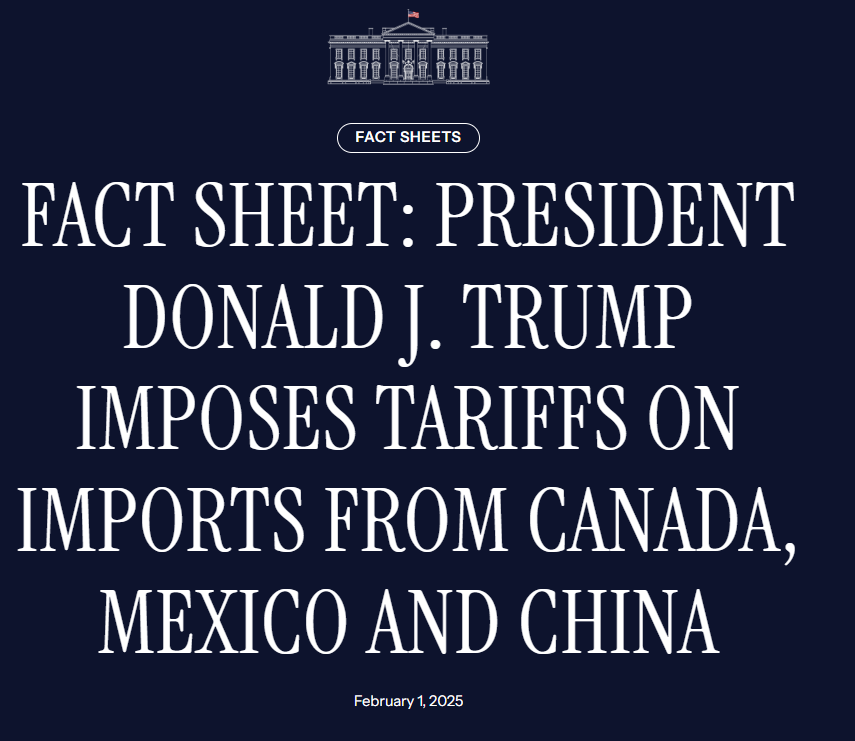
The move came as the deadline passed for Trump’s 10% tariffs on Chinese goods imported into the United States. Trump was expected to sign an executive order on Tuesday putting those tariffs into effect, according to the White House.
China strikes back at Trump, retaliating with tariffs as it ‘firmly opposes’ US plan, ABC News, Feb 4, 2025
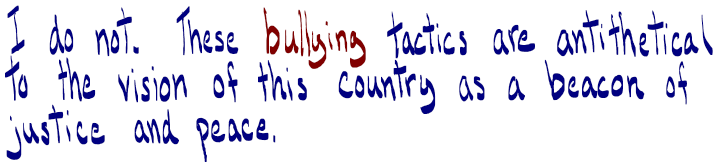
“No matter the intractable problem, Trump’s go-to playbook is to bully our neighbors through tariffs and to scapegoat immigrants. Instead of addressing the actual causes or seeking real solutions to the complex public health crisis surrounding fentanyl, Trump jumps to impose damaging and self-defeating across-the-board tariffs and to spout more hateful rhetoric that dehumanizes our immigrant neighbors.
“While tariffs can play a constructive role in protecting U.S. jobs and enforcing labor and environmental standards when part of a strategic industrial policy, Trump’s approach is neither strategic nor appropriate. Using tariffs to bully countries to advance an anti-immigrant and anti-humanitarian agenda will do nothing to support U.S. workers and will make our immigrant neighbors less safe.
Weaponizing Tariffs to Advance an Anti-Immigrant and Ill-Informed Agenda Does Not Make America Great by Public Citizen, Feb 2, 2025
But the past week’s trade policy showdown triggered outrage in Mexico and Canada. Spectators at National Hockey League and NBA games in Canada over the weekend booed the U.S. national anthem. The on-again, off-again trade war left companies throughout the United States puzzling over how much of Trump’s tariff talk was negotiating bravado and how much was real.
Trump halts tariffs on Canada and Mexico as both offer new border security plans. President Trump granted Mexico and Canada a 30-day reprieve on U.S. tariffs after both nations agreed to intensify efforts to block illicit drugs and migrants by David J Lynch and Mary Beth Sheridan, Feb 2, 2025
 unflinching