“To be Dakota is to live in peace and harmony with every living thing.”
Dakota War of 1862
There is an historical event that occurred on December 26, 1862. I was deeply moved by the movie Dakota 38 that was produced about those events, and the remembrance ride that was organized, and has become an annual tradition.
There is a fascinating interview with the filmmaker, A Conversation with Silas Hagerty: Dakota 38 by Richard Whittaker, Jul 28, 2012.
The Dakota War of 1862, also known as the Sioux Uprising, the Dakota Uprising, the Sioux Outbreak of 1862, the Dakota Conflict, or Little Crow’s War, was an armed conflict between the United States and several eastern bands of Dakota collectively known as the Santee Sioux. It began on August 18, 1862, when the Dakota, who were facing starvation and displacement, attacked white settlements at the Lower Sioux Agency along the Minnesota River valley in southwest Minnesota.[7] The war lasted for five weeks and resulted in the deaths of hundreds of settlers and the displacement of thousands more.[8] In the aftermath, the Dakota people were exiled from their homelands, forcibly sent to reservations in the Dakotas and Nebraska, and the State of Minnesota confiscated and sold all their remaining land in the state.[8] The war also ended with the largest mass execution in United States history with the hanging of 38 Dakota men.[8]
Smooth Feather
Following is the description of the film “Dakota 38” by Smooth Feather, who produced the video and includes a link to view the movie
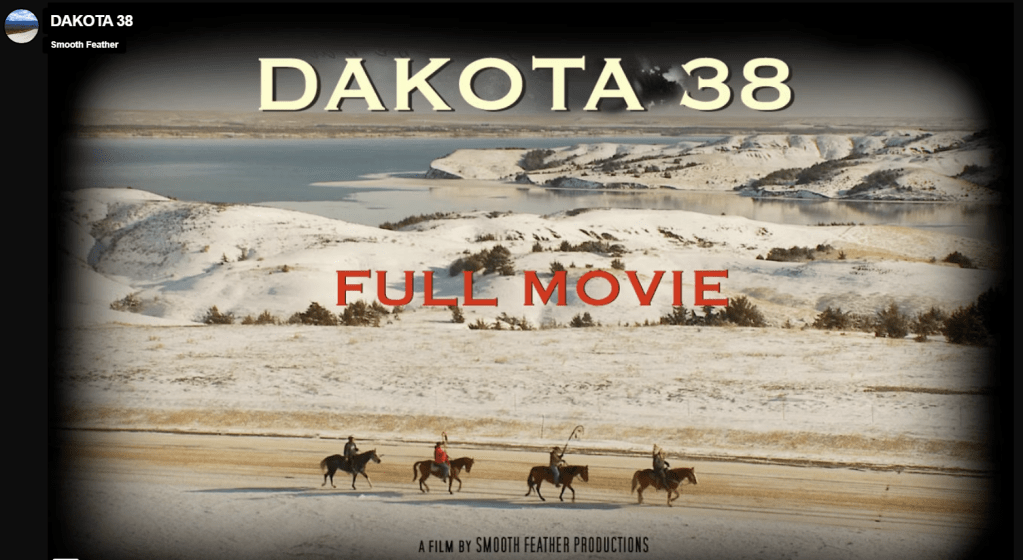
In the spring of 2005, Jim Miller, a Native spiritual leader and Vietnam veteran, found himself in a dream riding on horseback across the great plains of South Dakota. Just before he awoke, he arrived at a riverbank in Minnesota and saw 38 of his Dakota ancestors hanged. At the time, Jim knew nothing of the largest mass execution in United States history, ordered by Abraham Lincoln on December 26, 1862. “When you have dreams, you know when they come from the creator… As any recovered alcoholic, I made believe that I didn’t get it. I tried to put it out of my mind, yet it’s one of those dreams that bothers you night and day.”
Now, four years later, embracing the message of the dream, Jim and a group of riders retrace the 330-mile route of his dream on horseback from Lower Brule, South Dakota to Mankato, Minnesota to arrive at the hanging site on the anniversary of the execution. “We can’t blame the wasichus anymore. We’re doing it to ourselves. We’re selling drugs. We’re killing our own people. That’s what this ride is about, is healing.” This is the story of their journey- the blizzards they endure, the Native and Non-Native communities that house and feed them along the way, and the dark history they are beginning to wipe away.
This film was created in line with Native healing practices. In honoring this ceremony, we are screening and distributing “Dakota 38″ as a gift rather than for sale. This film was inspired by one individual’s dream and is not promoting any organization or affiliated with any political or religious groups. It was simply created to encourage healing and reconciliation.
Smooth Feather
https://www.smoothfeather.com/dakota38/
My Writings
In the context of the video that “was simply created to encourage healing and reconciliation,” looking back at the numerous articles I’ve written about this history, I find they are written from various perspectives. Some follow:
| Title | Date | Description | Link |
|---|---|---|---|
| Dakota 38 | 1/20/2016 | The book we will be reading for the next monthly community discussion at the Kheprw Institute (KI) is An Indigenous Peoples’ History of the United States (ReVisioning American History) by Roxanne Dunbar-Ortiz | https://jeffkisling.com/2016/01/20/dakota-38/ |
| Dakota 38 | 11/20/2019 | I’ve written about how trauma is passed from generation to generation. The events shown in the film “Dakota 38” occurred in 1862. “Today, all the people of the region continue to be affected by this traumatic event.” SUNKTANKA | https://jeffkisling.com/2019/11/20/dakota-38-2/ |
| Multigenerational Trauma and the US Dakota War of 1812 | 7/20/2022 | Multigenerational trauma and the US-Dakota War of 1862 | https://quakersandreligioussocialism.com/2022/07/07/multigenerational-trauma-and-the-us-dakota-war-of-1862/ |
| Dakota 38 + 2 | 12/26/2020 | The day after Christmas, Dec. 26, 1862, President Abraham Lincoln ordered the largest execution in United States history — the hanging of 38 Dakota (Sioux) men. At the heart of this is the genocide and land theft of the tribal nations by the white settler-colonialists. | https://jeffkisling.com/2020/12/26/dakota-38-2-2/ |
| Dakota 38 + 2 | 12/27/2022 | Composers Jay McKay and Jay Parrotta spent three years fusing sound and visuals into a cinematic experience that takes the viewer onto the Northern Plains and through a relentless pounding blizzard. Sound has the ability to transport, and the mix of chants, drums and melody is spellbinding. | https://quakersandreligioussocialism.com/2022/12/27/dakota-38-2/ |
| Forgive Everyone Everything | 12/27/2023 | As this message from Native News Online says, “But we also feel that there are several times each year where we should be remembering the historic events that brought us here today. That is why we are sharing this story in a standalone newsletter with you on this somber day of remembrance. Because history needs to be told so it is not forgotten.” | https://quakersandreligioussocialism.com/2023/12/27/forgive-everyone-everything/ |
| Scaffold | 5/31/2017 | A sculpture, called Scaffold, that was being installed at the Walker Art Center in Minneapolis, has created such controversy, especially in Native communities, that it is going to be removed. | https://jeffkisling.com/2017/05/31/scaffold/ |
| Dakota elder leadership and Scaffold | 6/5/2017 | I’ve written recently about the sculpture called Scaffold, that was being installed at the Walker Art Center in Minneapolis, and then about the mediation that occurred and resulted in the sculpture being removed from the art center. | https://jeffkisling.com/2017/06/05/dakota-elder-leadership-and-scaffold/ |
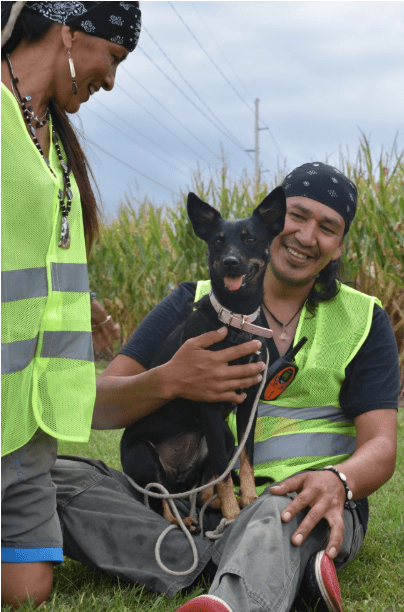
My friends Foxy and Alton Onefeather live near Lower Brule, where the ride begins.
Names of executed Indians
#1 was to be TA-TAY-ME-MA but he was reprieved because of his age and questions related to his innocence
- Plan-doo-ta, (Red Otter.)
- Wy-a-tah-ta-wa, (His People.)
- Hin-hau-shoon-ko-yag-ma-ne, (One who walks clothed in an Owl’s Tail.)
- Ma-za-bom-doo, (Iron Blower.)
- Wak-pa-doo-ta, (Red Leaf.)
- Wa-he-hua, _.
- Sua-ma-ne, (Tinkling Walker.)
- Ta-tay-me-ma, (Round Wind) — respited.
- Rda-in-yan-ka, (Rattling Runner.)
- Doo-wau-sa, (The Singer.)
- Ha-pau, (Second child of a son.)
- Shoon-ka-ska, (White Dog.)
- Toon-kau-e-cha-tag-ma-ne, (One who walks by his Grandfather.)
- E-tay-doo-tay, (Red Face.)
- Am-da-cha, (Broken to Pieces.)
- Hay-pe-pau, (Third child of a son.)
- Mah-pe-o-ke-na-jui, (Who stands on the Clouds.)
- Harry Milord, (Half Breed.)
- Chas-kay-dau, (First born of a son.)
- Baptiste Campbell, _.
- Ta-ta-ka-gay, (Wind Maker.)
- Hay-pin-kpa, (The Tips of the Horn.)
- Hypolite Auge, (Half-breed.)
- Ka-pay-shue, (One who does not Flee.)
- Wa-kau-tau-ka, (Great Spirit.)
- Toon-kau-ko-yag-e-na-jui, (One who stands clothed with his Grandfather.)
- Wa-ka-ta-e-na-jui, (One who stands on the earth.)
- Pa-za-koo-tay-ma-ne, (One who walks prepared to shoot.)
- Ta-tay-hde-dau, (Wind comes home.)
- Wa-she-choon, (Frenchman.)
- A-c-cha-ga, (To grow upon.)
- Ho-tan-in-koo, (Voice that appears coming.)
- Khay-tan-hoon-ka, (The Parent Hawk.)
- Chau-ka-hda, (Near the Wood.)
- Hda-hin-hday, (To make a rattling voice.)
- O-ya-tay-a-kee, (The Coming People.)
- Ma-hoo-way-ma, (He comes for me.)
- Wa-kin-yan-wa, (Little Thunder.)
Forgive Everyone Everything
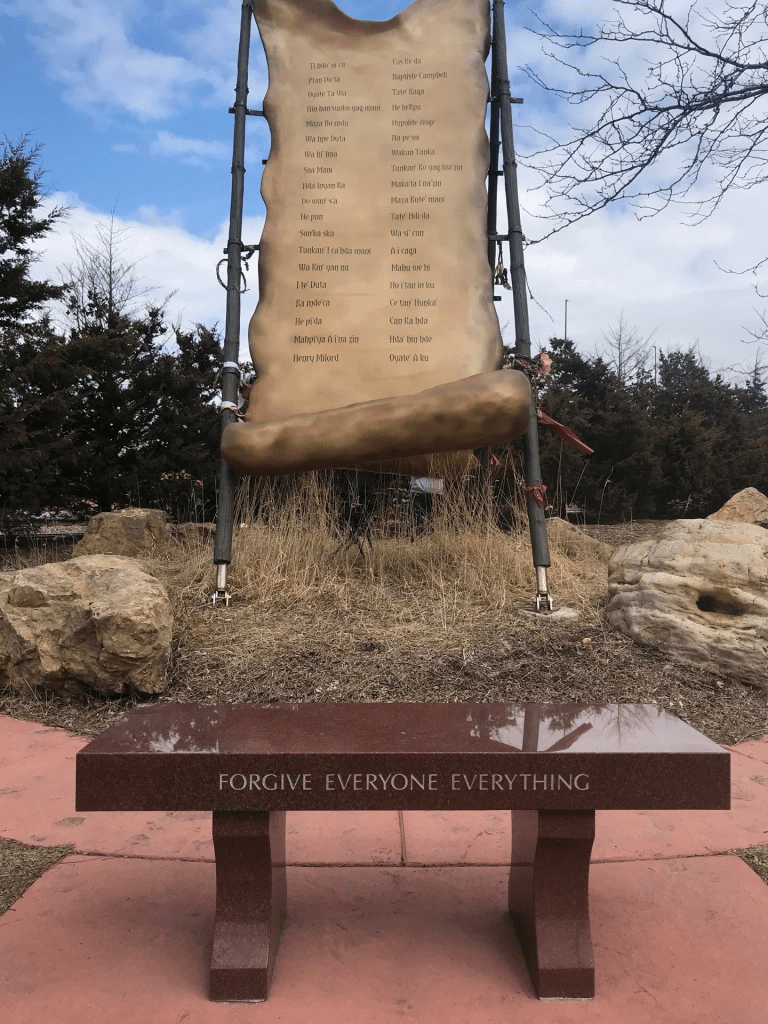
FORGIVE EVERYONE EVERYTHING is inscribed on a bench in Reconciliation Park, Mankato, Minnesota, where the ride ends. The photo of the memorial shows a list of the names of the 38 Dakota men who were all hanged at the same time in what is now Mankato, Minnesota. A raised wooden platform, with 38 nooses along the sides, was constructed. It is said nearly 4,000 people witnessed this, the largest execution in U.S. history, on December 26, 1862.
As to who needs to be forgiven, there are many answers to that.
At the heart of this is the genocide and land theft of the tribal nations by the white settler-colonialists.
 unflinching