

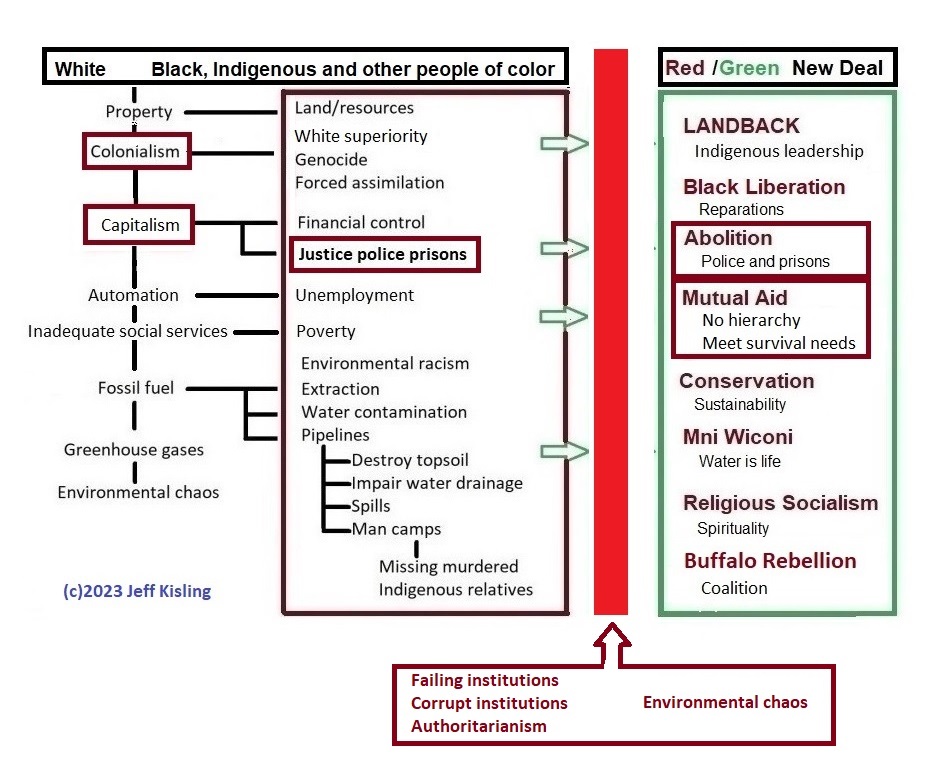
I’ve been working on the following diagram for years as a way to express the relationships between numerous concepts related to justice and peace. The White column shows the systems that come from colonialism and capitalism. The column for Black, Indigenous and other people of color shows the impact of those injustices in these communities that are created by colonialism and capitalism.
On the one hand, the beauty of democracy, opportunity, freedom, and equality (for some). On the other hand, the brutality that made that beauty possible: colonization, genocide, enslavement, occupation, and war.
Viet Thanh Nguyen
I struggled to explain why this past presidential election was about much more than which candidate won. I wrote Being a Global Citizen that discusses this. But I wasn’t satisfied with what I wrote there. Recently, my friend Harold Page-Jamison captured what I was trying to say:
“I can think of no greater failure of solidarity and no greater expression of privilege than prioritizing the preservation of our own rights and comforts over the protection of others from starvation and death.” Harold Page-Jamison

Donald Trump does not represent something new in the United States. Instead, he is part of a fundamental contradiction that the United States was born from, a contradiction that has never gone away. On the one hand, the beauty of democracy, opportunity, freedom, and equality (for some). On the other hand, the brutality that made that beauty possible: colonization, genocide, enslavement, occupation, and war. Some willingly embrace the brutality, others are willing to look away from it. That is why the Democratic Party’s loss of its moral compass on Gaza and calling what Israel is doing a genocide was not simply a “single issue,” but a symptom of the rot within a party that hoped that the beauty of multiculturalism and diversity would somehow be enough to overcome the brutality.
So long as that contradiction between beauty and brutality is not resolved, it will return, and the country – and the world – will be haunted by the original sins that made this country and are still a part of this country. Too many Americans benefit from the contradiction, which has shaped the US into what it is today: a military-industrial complex that is profitable for some, and a global hegemonic power that justifies itself through the narratives of American Exceptionalism and the American Dream.
…
Trump’s nostalgia is an attempt at rebranding, with the implied promise of returning to a 19th-century America where white men were white men. The threats of detention camps and mass deportation are a naked gesture at racially purifying the United States, a fantasy that ignores the economic reality that the United States needs the easily exploitable (most likely poor and working-class immigrants from nonwhite countries) to work its lowest-paid jobs. But this is a capitalist system whose logic is ultimately about the maximum extraction of labor for the most minimal amount of pay, which damages not just economically disadvantaged people of color but also white people, from the poor and working class to the precarious middle class.
‘I Am Disappointed, Fearful, Numb.’ Pulitzer Prize Winner Viet Thanh Nguyen Reflects on Trump ‘Racially Purifying’ the US. The acclaimed novelist’s essay on the Republicans’ attempt to take us back to the 19th century – and where he finds hope. By Viet Thanh Nguyen, zeteo, Nov 16, 2024
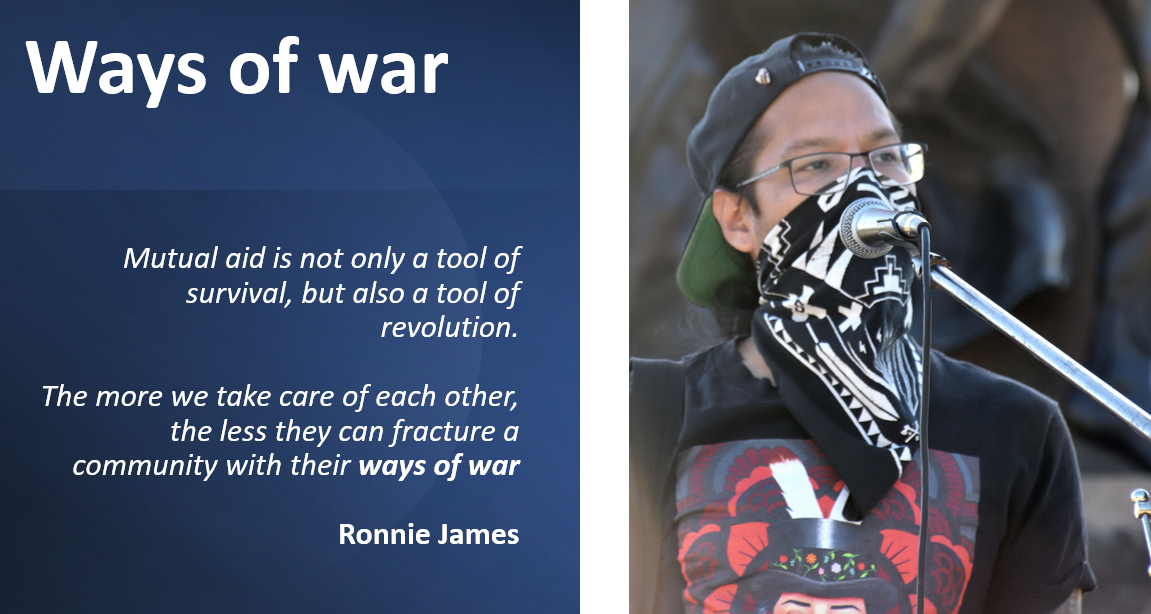
I’m of the firm opinion that a system that was built by stolen bodies on stolen land for the benefit of a few is a system that is not repairable. It is operating as designed, and small changes (which are the result of huge efforts) to lessen the blow on those it was not designed for are merely half measures that can’t ever fully succeed.
So the question is now, where do we go from here? Do we continue to make incremental changes while the wealthy hoard more wealth and the climate crisis deepens, or do we do something drastic that has never been done before? Can we envision and create a world where a class war from above isn’t a reality anymore?”
Ronnie James, Des Moines Mutual Aid






 unflinching