

We Will Dahiya You is the title of Mehdi Hasan’s video published yesterday which explains what the Dahiya Doctrine is. The Doctrine is the basis of Israel’s military
strategy in Gaza , and now Lebanon ,
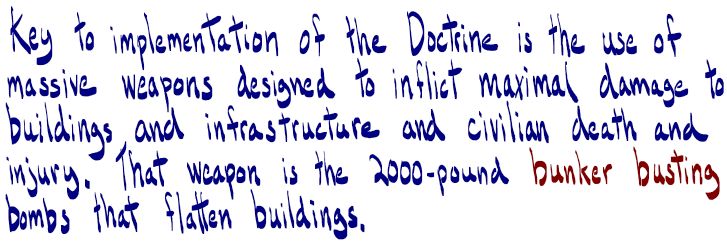
Key to implementation of the Doctrine is the use of massive weapons designed to inflict maximal damage to buildings and infrastructure and civilian death and injury . That weapon is the 2000- pound bunker busting bombs that flatten buildings .
Those 2000- pound bombs are supplied to Israel by this country . Meaning the Biden administration knowingly approves of Israel’s Dahiya Doctrine . The Biden administration is knowingly breaking International Humanitarian Law.
“The Dahiya doctrine calls for the Israeli military to intentionally, deliberately, cynically, inflict long-lasting and disproportionate damage onto the enemy, no matter how bad the civilian consequences,” Mehdi says. “AKA, exactly what we’re seeing in Lebanon now, and in Gaza for the past year.”
‘We Will Dahiya You’: Mehdi Breaks Down the Israeli Military Plan For Flattening Lebanon and Gaza
Dahiya Doctrine (2024, September 28) Wikipedia.
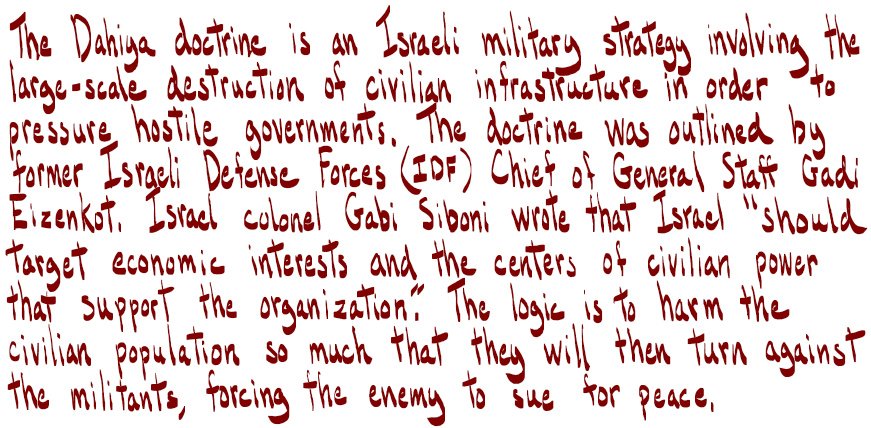
The Dahiya doctrine is an Israeli military strategy involving the large- scale destruction of civilian infrastructure in order to pressure hostile governments . The doctrine was outlined by former Israeli Defense Forces (IDF) Chief of General Staff Gadi Eizenkot , Israel colonel Gabi Siboni wrote that Israel ” should target economic interests and the centers of civilian power that support the organization. The logic is to harm the civilian population so much that they will then turn against the militants, forcing The enemy to sue for peace,
What is the Dahiya Doctrine?
- The Dahiya Doctrine is an Israeli military doctrine that calls for the use of massive, disproportionate force and the deliberate targeting of civilians and civilian infrastructure.
What are the origins of the Dahiya Doctrine?
- The doctrine is named after the Dahiya suburb of Beirut, where the Lebanese paramilitary group Hezbollah has its headquarters, which the Israeli military leveled during its assault on Lebanon in the summer of 2006 that killed nearly 1,000 civilians, about a third of them children, and caused enormous damage to the country’s civilian infrastructure, including power plants, sewage treatment plants, bridges, and port facilities.
- It was formulated by then-General Gadi Eisenkot when he was Chief of Northern Command. As he explained in 2008 referring to a future war on Lebanon: “What happened in the Dahiya quarter of Beirut in 2006 will happen in every village from which Israel is fired on… We will apply disproportionate force on it (village) and cause great damage and destruction there. From our standpoint, these are not civilian villages, they are military bases… This is not a recommendation. This is a plan. And it has been approved.” Eisenkot went on to become chief of the general staff of the Israeli military before retiring in 2019.
- While it became official Israeli military doctrine after Israel’s 2006 attack on Lebanon, Israel’s military has used disproportionate force and targeted Palestinian, Lebanese, and other civilians since Israel was established in 1948 based on the ethnic cleansing of indigenous Palestinians, including dozens of massacres to force them to flee for their lives.
Is the Dahiya Doctrine legal?
- International law expressly prohibits the use of disproportionate force and the targeting of civilians and civilian infrastructure, which are war crimes. As noted by the International Committee of the Red Cross:
“Applying the principle of proportionality is critically important for protecting civilians and critical infrastructure in situations of armed conflict… an attack against a military objective can be lawful only if the principles of proportionality and precautions are respected, meaning that the incidental civilian harm must not be excessive, and the attacker must have taken all feasible precautions to avoid this harm or at least reduce it.”
- Article 51 of the Fourth Geneva Convention prohibits attacks ‘which may be expected to cause incidental loss of civilian life, injury to civilians, damage to civilian objects, or a combination thereof, which would be excessive in relation to the concrete and direct military advantage anticipated.”
Explainer: The Dahiya Doctrine & Israel’s Use of Disproportionate Force, Institute for Middle East Understanding (IMEU), July 31, 2024
Reportedly, Israeli jets dropped more than 80, 2000-pound “bunker-busting” bombs that have a destruction radius of 35 metres (115 feet) on their target. The strike that killed Nasrallah also flattened six residential buildings. Similar Israeli attacks in the past two weeks have wreaked havoc on civilian infrastructure in Beirut and across Lebanon. The death toll in Lebanon has now crossed the 1000 mark and a million people have fled their homes.
Of course, the most severe display of the Dahiyeh Doctrine has been during Israeli’s ongoing genocidal campaign in Gaza. Since October 7, Israel’s apparent strategy of targeting Gaza’s civilian population and infrastructure with the full force of the military to try and deter Hamas has brought a catastrophe comparable only to the Nakba of 1948. In just a year, Israel’s military completely devastated all infrastructural and institutional bases of Palestinian civilian life in Gaza.
That Israel has been allowed to pursue the wholesale destruction of civilian life as a military objective, first in Lebanon, then repeatedly in Gaza, then again in Lebanon, with complete impunity is a grim reminder of the extent to which the peoples of the region have been devalued and dehumanised. Their lives seem to count for so little that rather than being condemned as a blatant assault on international law and morality, the “Dahiya Doctrine” appears to have been accepted by those leading the global community – Israel’s Western allies and backers – as a legitimate pathway to achieving regional stability
‘Dahiyeh Doctrine’ returns to Dahiyeh. Israel’s strategy of destroying civilian life to deter its adversaries reached its peak in Gaza, and has now returned to its namesake – Beirut’s Dahiyeh. Somdeep Sen, Associate Professor of International Development Studies at Roskilde University, Aljazeera, Oct 3, 2024
International Humanitarian Law
International humanitarian law bans the use of disproportionate force and the targeting of civilians and civilian infrastructure during war.
Article 51 of Geneva Protocol I prohibits bombardment that treats a number of clearly separated and distinct military objectives located within a city as a single military target.
“Applying the principle of proportionality is critically important for protecting civilians and critical infrastructure in situations of armed conflict,” according to the International Committee of the Red Cross.
“An attack against a military objective can be lawful only if the principles of proportionality and precautions are respected, meaning that the incidental civilian harm must not be excessive, and the attacker must have taken all feasible precautions to avoid this harm or at least reduce it,” says the ICRC.
The Dahiya Doctrine: How is Israel using this strategy in its war on Lebanon? Repeating its strategy of the 2006 summer war, Israel has already flattened wide areas in Beirut’s southern suburbs and elsewhere in Lebanon. The New Arab Staff, October 8, 2024



 unflinching