newspeak, propagandistic language that is characterized by euphemism, circumlocution, and the inversion of customary meanings. The term was coined by George Orwell in his novel Nineteen Eighty-four (1949). Newspeak, “designed to diminish the range of thought,” was the language preferred by Big Brother’s pervasive enforcers.
Types of newspeak in Orwell’s Nineteen Eighty-four include the elimination of certain words or the removal of unorthodox meanings from certain words; the substitution of one word for another (e.g., uncold instead of warm and ungood instead of bad); the interchangeability of the parts of speech, such that any word in the language could be used as either noun, verb, adjective, or adverb (e.g., the word cut no longer existed, and the term knife acted as both noun and verb, as in the sentence “She knifed the bread”); and the creation of words for political purposes (e.g., goodthink, meaning “orthodoxy” or “to think in an orthodox manner”).
“Expressive activity”
The University of Wisconsin-Madison uses that term in its new policies related to protests on campus.
The University of Wisconsin-Madison’s new protest policy may be unconstitutional, a constitutional law expert told The Daily Cardinal Thursday.
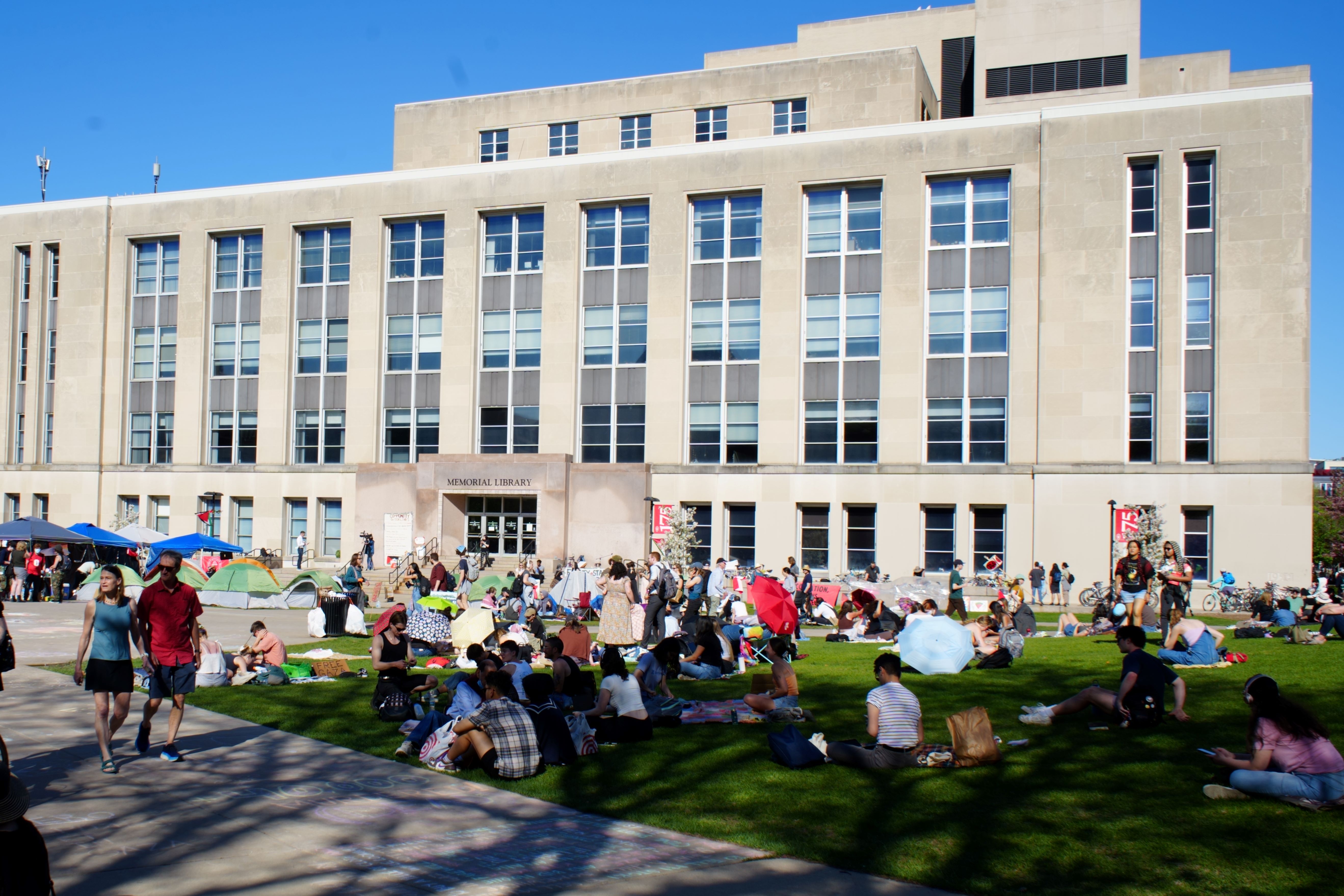
UW-Madison updated its protest policy Wednesday to include restrictions on “expressive activity” within 25 feet of university facility entrances, size limitations for signs in buildings, specific sound amplification restrictions and restrictions on protest activity during select times on campus areas.
Although the policy isn’t trying to limit “individuals speaking directly to one another” such as conversation, free speech and constitutional law, expert Howard Schweber said a conversation between friends, the distribution of newspapers or pamphlets, singing or wearing political merchandise could all be prohibited within 25 feet of UW-Madison facility entrances.
Schweber said the university limiting “expressive activity” within 25 feet of building entrances is “extremely problematic, clearly unconstitutional” and “begging to invite some judge to strike them down.”
New UW-Madison protest policy ‘clearly unconstitutional,’ free speech expert says. Singing, distributing newspapers and more “expressive activities” could be banned within 25 feet of university buildings under new protest guidelines announced ahead of the fall semester by Noe Goldhaber, The Daily Cardinal, August 30, 2024
Indiana University’s “Expressive Activity Policy” is so absurd that it actually sets times when expressions of free speech are not allowed (11 pm – 6 am) and is being challenged by the ACLU of Indiana.
INDIANAPOLIS, Ind. — The ACLU of Indiana today filed a lawsuit in U.S. District Court on behalf of ten plaintiffs challenging Indiana University’s new “Expressive Activity Policy.”
The lawsuit alleges that the policy, which prohibits “expressive activity” between the hours of 11 p.m. and 6 a.m. and threatens harsh punishments, including suspension or expulsion for students, and suspension or termination of staff, is overly broad and violates the First Amendment.
Ken Falk, ACLU of Indiana legal director, issued the following statement:
“IU has approved a new policy that prohibits all expressive activity if it takes place between 11 p.m. and 6 a.m., even if the activity is not at all disruptive, such as standing silently, holding a sign, wearing a t-shirt with a communicative message, or discussing current events with friends. The protections of the First Amendment do not end at 11:00 p.m., only to begin again at 6:00 a.m.”
ACLU of Indiana Sues Indiana University Over Expressive Activity Policy
UW-Madison Expressive Activity Policy UW-6013
The UW-Madison is a public university and, as a matter of law and institutional values, is dedicated to the principles of free speech and free expression as protected by the First Amendment of the U.S. Constitution and considers that dedication to be an essential part of its educational mission. Fulfilling the university’s mission requires that UW-Madison robustly protect the opportunity of our community to engage in expressive activity in a variety of ways and locations. We also have the responsibility to ensure that teaching, research, scholarship, service, and university-sponsored events can occur in a safe and orderly manner without disruption and in a manner that is open and welcoming. It is entirely consistent with the First Amendment for UW-Madison to impose reasonable restrictions on the time, place, and manner of expressive activity (e.g., events, protest, demonstrations; see definitions below) on its campus. These robust protections alongside reasonable restrictions work together to ensure our campus can fulfill our obligations under the First Amendment alongside our responsibilities to our educational mission, and to a safe and functional environment for teaching, research, and learning for all our students, faculty, and staff.
This policy thus strongly affirms UW-Madison’s commitment to the free and open exchange of ideas through expressive activity and protects the rights of individuals on campus to engage in expressive activity consistent with the U.S. and Wisconsin Constitutions. It also sets forth rules that support a safe environment, protect university and private property, and promote the orderly and efficient function of the university’s teaching, research, and public service missions as well as ongoing and necessary operations.
This policy shall never be enforced in a way that discriminates against the viewpoints held by members of the university community. Nor will it be enforced in a manner that discriminates against any protected characteristic under non-discrimination laws applicable to UW-Madison.Definitions:Expressive Activity Any activity protected by the First Amendment of the United States Constitution and Article I of the Wisconsin Constitution, including but not limited to, speech, lawful assembly, protesting, distributing literature, and chalking. Commercial activity (related to a commercial transaction or an advertisement to promote the sale of goods or services) is excluded and governed by Wis. Admin. Code UWS § 18.11(8) and UW-6012 Commercial Use of Facilities, Incentives, and Acceptance of Gifts. Expression and activities that fall outside of the First Amendment’s and Article I’s protection are likewise not permitted under this policy.Noise Disturbance Intentionally creating a volume of noise that unreasonably interferes with university-sponsored or university-authorized activities (Wis. Admin. Code UWS § 18.11(4)(a)3). Sound measured at or above 85 decibels in an indoor area 50 feet or more from the source of the noise is presumed to create a noise disturbance unless exempted or authorized by the university.
As an example, if the sound of expressive activity as heard in a classroom or office at least 50 feet away is at the level of 85 decibels or higher (e.g., equivalent of a running lawnmower or kitchen blender), the outdoor expressive activity is presumed to create a noise disturbance and must reduce the volume or risk being declared an unlawful assembly that must disband.Outdoor Public University Areas Unsecured and unrestricted outdoor spaces of university owned or controlled property that are generally open and available to the public for use and enjoyment, this does not include State Street Mall. State Street Mall is controlled by the City of Madison and is regulated differently than university property. Similarly, many sidewalks, streets, and private properties adjacent to university property are controlled by their owners including the City of Madison and the State of Wisconsin, which may have different policies and laws governing their use. UW-Madison reserves the right to delineate some outdoor campus spaces as falling outside of this definition; if it does so, other rules may apply.Postings Physical display conveying a message to the reader that is intended to be or is affixed to bulletin boards, buildings, or other objects. Postings include the projection of images.Sound Amplification Any device or machine which is capable of amplifying sound and capable of delivering an electrical input of one or more watts to a loudspeaker (Wis. Admin. Code § UWS 18.11(5)(c)) (e.g, public address systems, loudspeakers, musical amplifiers). Excluded from this definition are battery powered and handheld amplification devices such as a personal Bluetooth speaker or bullhorn.University Community Members University employees (including faculty members and staff), students, Registered Student Organizations.University Property All buildings, lands, and other internal and external spaces owned or controlled by the university and the Board of Regents. University Property includes Outdoor Public University Areas.Visitor Any individual or group who is not a University Community Member.Policy:
- Permitted Expressive Activity
- University community members as well as visitors may use outdoor public university areas for expressive activity, subject to the restrictions listed in this policy.
- The university shall not consider the content or viewpoint of any expressive activity permitted by university policy when applying restrictions as outlined in this policy.
- Unless otherwise regulated by this or other applicable policies, university community members and visitors may engage in spontaneous expressive activity unless otherwise restricted by law, university policy, or prior space reservations.
- If university community members and visitors expect exclusive use of those outdoor public university areas that can be reserved for an event or activity, reservations must be made in accordance with the university’s Facility Use Policies.
- All expressive activity must comply with applicable law (state and federal), including, but not limited to, Wis. Admin. Code UWS § 18, Conduct on University Lands, as well as university policy.
- Restrictions on Expressive Activity at UW-Madison
- Lawful Activity
- Any conduct, including expressive activity, must comply with applicable state and federal laws. This includes state and federal regulations and lawful directives and orders from the federal and state governments.
- Those seeking to engage in expressive activity on university property, including outdoor public university areas, are expected to educate themselves about the laws, regulations, directives, and orders that may affect the considered expressive activity.
- Expressive activity that is not protected by the First Amendment or Article I of the Wisconsin Constitution is likewise not permitted under this policy.
- Compliance with University PolicyAll conduct on university property, including expressive activity, must comply with university policy, including but not limited to this policy, Facility Use Policies, Wis. Admin. Code UWS § 17, Wis. Admin. Code UWS § 18, and non-discrimination policies, including but not limited to provisions prohibiting harassment.
- Material and Substantial Disruption to University Activities, Events and OperationsExpressive activity may not materially and substantially disrupt university activities, events, or operations. This includes, but is not limited to:
- Disrupting the teaching of classes, study, research, or administration of the university;
- Impairing passage on university lands and through building corridors, stairways, doorways, building entrances, fire exits, and reception areas leading to offices;
- Interfering with university authorized or reserved use of university property, including, but not limited to, disrupting Registered Student Organizations (RSOs) and university-invited speakers and other authorized talks or events;
- Interfering with or infringing on the rights and privileges of others on university property including in outdoor university public areas;
- Impeding or disrupting emergency services, including but not limited to, fire protection, law enforcement, or emergency or medical services.
- Location
- To mitigate the potential for disruption and facilitate orderly access to university operations, classes, research, events, programming, and other activities, the university prohibits expressive activity within 25 feet of entrances to university owned or controlled buildings and facilities. For this section, the focus is on expressive activity aimed to reach beyond individuals speaking directly to one another. Examples include but are not limited to concerted activity such as:
- Protests
- Chants
- Speeches
- The University of Wisconsin Police Department (UWPD) maintains authority to increase the mandatory distance for any expressive activity where necessary to allow access to university property (including outdoor public university areas) or to protect the safety of individuals or university property.
- To mitigate the potential for disruption and facilitate orderly access to university operations, classes, research, events, programming, and other activities, the university prohibits expressive activity within 25 feet of entrances to university owned or controlled buildings and facilities. For this section, the focus is on expressive activity aimed to reach beyond individuals speaking directly to one another. Examples include but are not limited to concerted activity such as:
- Public SafetyExpressive activity on university property, including in outdoor public university areas, must comply with Wis. Admin. Code § UWS 18.10. Such activity must not physically injure any other person, damage or destroy property, physically interfere with another person’s bodily autonomy, or engage in constitutionally unprotected true threats against others. Examples of impermissible activity include, but are not limited to:
- Physically harming another;
- Inappropriate and unwelcome physical contact with another person, including, but not limited to, pushing, slapping, or spitting;
- Acting in a manner that shows reckless disregard for the physical health or physical safety of any other person.
- Obstructing Access to University Lands, Buildings, Events or Impeding the Movement of OthersConduct on university property and in outdoor public university areas, including expressive activity, must not obstruct or seriously impair the passage of others on university lands and through university facilities, including but not limited to, corridors, stairways, doorways, building entrances, fire exits, and reception areas. See Wis. Admin. Code §§ UWS 18.11(4)(a)1 and 2.b.
- Commencement and Other Core Commemorative Photo Locations
- Statue of Abraham Lincoln and Surrounding Area.
- The area immediately in front of and immediately surrounding the statue of Abraham Lincoln at the top of Bascom Hill is designated for priority use by university community members and visitors to take photographs with the statue during the following time periods:
- From the Sunday before the first day of instruction for the fall semester to the Sunday after the first day of instruction for the fall semester; and
- From the Sunday before university-wide commencement in the winter to the Sunday after university-wide commencement in the winter; and
- From the Sunday before university-wide commencement in the spring to the Sunday after university-wide commencement in the spring.
- The area immediately in front of and immediately surrounding the statue of Abraham Lincoln at the top of Bascom Hill is designated for priority use by university community members and visitors to take photographs with the statue during the following time periods:
- During the above identified times, individuals may never block access to the statue of Abraham Lincoln, prevent the orderly formation of a line for photographs with the statue of Abraham Lincoln; or obstruct, impair or otherwise interfere with photographs with the statue of Abraham Lincoln.
- Other forms of expressive activity may continue in the area surrounding the statue during these periods if it meets the requirements of this section and otherwise complies with the limitations set forth elsewhere in this policy.
- Statue of Abraham Lincoln and Surrounding Area.
- Graduation Numbers on Bascom Hill
- Whenever the graduation numbers adorn the bottom of Bascom Hill, the area immediately in front of and immediately surrounding the graduation numbers is designated for priority use by university community members and visitors to take photographs with the graduation numbers.
- During that time, individuals may not block access to the graduation numbers; prevent the orderly formation of a line for photographs with the graduation numbers; or obstruct, impair or otherwise interfere with photographs with the graduation numbers.
- Expressive activity may continue in the bottom portion of Bascom Hill during these periods if it meets the requirements of this section, the provisions of UW-6000 Use of Facilities and Land related to the bottom portion of Bascom Hill, and otherwise complies with the limitations set forth elsewhere in this policy.
- Camping and StructuresCamping, as defined in Wis. Admin. Code § UWS 18.07(4), is expressly prohibited on all university property including outdoor public university areas. In addition, no person may place or erect any facility or structure upon university lands unless authorized by the chancellor or designee (Wis. Admin. Code § UWS 18.07(7)).
- Sound Amplification
- Conduct on university property including outdoor public university areas may not include the use sound amplification equipment unless expressly applied for and authorized by the university. This prohibition extends to expressive activity.
- Under state law, authorization may be granted between the hours of 12PM-1:30PM and 5PM-7PM, every day. Applicants must show there is a need for the use of sound amplification equipment to communicate with the identified audience and that its use will not interfere with or disrupt university operations. This paragraph does not apply to the use of battery powered handheld devices such as handheld Bluetooth speakers and bull horns. However, use of those devices must comply with all other provisions of this policy, all other applicable university policies, as well as state and federal law. The application process may be found at https://finadmin.wisc.edu/facility-guidelines-forms/. For further information please see Wis. Admin. Code § UWS 18.11(5)(a).
- During the university’s final exam period, beginning with Study Day and ending the day following the last day of exams, the use of sound amplification devices – including, but not limited to, handheld battery-operated devices such as Bluetooth speakers and bullhorns – is expressly prohibited. Information regarding the timing of finals period is reflected in the university’s academic calendar.
- NoiseConduct, including expressive activity, must not create, or assist in creating, a noise disturbance. Please note that conduct, including expressive activity may not disrupt university operations, activities, and events in violation of items in the Material and Substantial Disruption to University Activities, Events and Operations section of this policy, even if it does not amount to a noise disturbance.
- Hand-held Signs and Written Materials for Distribution
- Outdoor Public University Areas
- University community members and visitors may hold signs and distribute written or printed non-commercial materials, such as flyers, leaflets, and publications on a person-to-person basis, unless otherwise regulated by university policy, including but not limited to, individual building use policies.
- Signs must be handheld and may not be left unattended.
- Unless otherwise authorized by university policy (e.g., reserved use of the bottom third of Bascom Hill), no signs may be erected or supported by piercing the surface of university property with stakes, posts, poles, anchors, or other materials. See UW-6000 Use of Facilities and Land.
- Indoor spaces
- University community members and visitors may hold signs and distribute written or printing non-commercial materials, such as flyers, leaflets, and publications on a person-to-person basis, unless otherwise restricted by university building use policies. See G-1 Use of Lobbies in Academic Buildings and inquire with individual building managers for more information.
- Signs must be limited to no larger than three feet by three feet.
- Signs must be handheld and may not be supported by standards or sticks.
- No materials may be distributed in classrooms.
- Signs or materials for distribution that violate university policy, including this policy, or state or federal law, are prohibited.
- An authorized official of the university may remove and destroy any signs or written materials left behind or unattended.
- Distribution of written materials in residence halls is governed by applicable University Housing residence hall policies.
- Outdoor Public University Areas
- Postings
- Postings in outdoor public university areas are limited to general bulletin boards and kiosks (Wis. Admin. Code § UWS 18.08(9)(a))
- Postings in outdoor public university areas must not be affixed to telephone poles, light poles, garbage cans, sidewalks, stairs/steps, benches, fences, trees, buildings, or Bascom Hill (without a reservation under policy UW-6000 Use of Facilities and Land). As defined in this policy, postings include projection of images.
- Except where otherwise indicated, postings must not exceed 11 inches by 17 inches and only one copy of a posting may be posted in the same designated space at any one time.
- An authorized university official may remove and destroy the following postings:
- Unauthorized or outdated postings (e.g., materials publicizing a past event/activity or duplicate materials posted on the same bulletin board);
- Any postings at the end of each semester, at regular intervals as established by the university, or as part of regular maintenance and cleaning by university personnel acting within the scope of their university duties; and
- Postings that violate university policy, including this policy, or state or federal law.
- University community members and visitors may not remove, cover, or tamper with postings posted by another person or organization.
- Posting in residence halls is governed by applicable University Housing residence hall policies.
- In campus buildings, the posting of fliers and posters is only allowed on bulletin boards. In most cases, departmental bulletin boards are maintained and regulated by individuals in the department’s main office. Sometimes the caretaker of the bulletin board is listed on the bulletin board itself. Postings in university buildings must comply with building specific posting policies.
- ChalkingChalking is permitted on university sidewalks and university streets subject to the following restrictions:
- Chalking may only be done with water soluble materials. No paint, oil-based chalk, indelible marks, or spray chalk may be used.
- Chalking is prohibited on university buildings, courtyard areas, vertical surfaces, planters, doors, trash receptacles, steps, fountains, benches, tables, signs, poles, columns, bus stops, light posts, trees, arches of bridge walkways, the Lakeshore Path, underneath overhangs or any covering, or any location where precipitation cannot wash away the chalk.
- Students, faculty, staff, and members of the public must not remove or tamper with chalking done by another person or organization.
- The university may remove chalking and other markings on university property, including outdoor public university areas, that violate university policy, including but not limited to this policy, or state or federal law.
- Chalking as permitted by this policy is subject to regular maintenance and cleaning by authorized university personnel acting within the scope of their university duties.
- If natural conditions have not removed chalk from university sidewalks and streets, highly chalked areas will be cleaned on a weekly basis.
- Lawful Activity
- Exceptions: This policy does not apply to authorized university operations, including but not limited to construction and maintenance or to university personnel carrying out an authorized university service or activity while acting within the scope of their university duties and responsibilities.









 unflinching